Buyer behavior shifted faster than most B2B marketing teams noticed. According to VP Principal Analyst Amy Bills, 94% of B2B buyers now use AI in purchasing decisions - and they’re using it early, before a single sales call or demo request. Reveation Labs found that 50% of B2B software buyers begin their research in AI chatbots rather than Google, a 71% increase in just four months. That means your vendor narrative is being shaped by ChatGPT, Perplexity, and Gemini before your SDR ever picks up the phone.
This is why an aeo strategy for b2b has become a revenue decision, not a marketing experiment. Zoe Ashbridge of HubSpot reports that B2B buyers start with 7.6 potential vendors and narrow to 3.5 before any direct engagement. AI filters that shortlist. Brands absent from AI answers aren’t losing deals in the consideration phase - they’re never entering the conversation.
This guide covers 10 concrete tactics to build AI presence in 2026, organized into the five strategic priorities that matter most for B2B teams.

Why traditional SEO is no longer enough for B2B buyers
Tactic 1 - Run an AI visibility audit. Tactic 2 - Build measurement infrastructure from day one.
The numbers are harder to ignore than most marketers want to admit. Sixty percent of searches now end without a click to a third-party website. Rankings that took years to build don’t translate to AI visibility - 34.5% of brands are completely absent from AI search results even when they rank well in Google. You can hold position one on Google and still be unknown to the AI systems your buyers are actively querying.
Enoch Pakanati at The Smarketers puts the citation dynamic plainly: “89% of domains cited by at least one major AI engine are cited by only one.” Only 11% of cited domains appear across both ChatGPT and Perplexity for identical queries. Platform fragmentation is real, and treating “AI search” as a monolith is a strategic mistake. ChatGPT Search rewards conversational content that anticipates follow-up questions. Perplexity favors data-heavy content with clear source attribution. Google Gemini responds best to structured comparison content. These aren’t minor differences - they require distinct optimization priorities.
Tactic 1 is to run a prompt audit before producing a single piece of new content. Identify 15-25 core prompts that define your category - the exact questions your buyers are entering into AI assistants right now. Query each platform and document where you appear, how you’re described, and who’s consistently cited instead of you. This is your baseline.
Tactic 2 is measurement infrastructure. Dan Stillgoe, who has reviewed 25 AEO audits for B2B companies across industries, uses Scrunch for prompt tracking, calling it “transformational for the channel.” For teams without specialized tools, custom channel groups in Google Analytics 4 can separate AI referral traffic from organic. Track sessions, conversion rates, and revenue attribution from AI sources as a distinct channel. Shana Murik, Head of Marketing at , argues that AEO must integrate into existing measurement frameworks: a strong AEO approach needs “measurable business impact” built in from the start, not added as an afterthought.
The 70/30 split - 70% traditional SEO, 30% AEO-specific initiatives - is a practical starting point for most B2B teams that aren’t ready to restructure their entire content operation. SEO provides the technical and authority foundation. AEO extracts value from that foundation by positioning content for AI extraction.
Structure content so AI can actually extract it
Tactic 3 - Answer-first formatting. Tactic 4 - Deploy structured schema markup.
Content structure is where most B2B companies leave the most AI visibility on the table. Enoch Pakanati at The Smarketers identifies the core principle: AI engines reward “the page with the highest information gain that is also structurally easiest to extract” - not the longest page, not the most comprehensive guide, and not the most internally-linked article. Ease of extraction matters as much as quality of content.
Dan Stillgoe’s finding from 25 B2B AEO audits is direct: “A 1,000-word piece solving a specific problem will outperform a 5,000-word generic guide almost every time.” B2B content teams have spent years producing the latter. The instinct to cover every angle in one document works against AI extractability, which favors tight, answerable content organized around specific questions.
Pakanati also notes that the skyscraper era is over. Generative engines detect paraphrasing at a token level, so rehashing competitors’ content - the dominant SEO content strategy for a decade - produces nothing AI models want to cite.
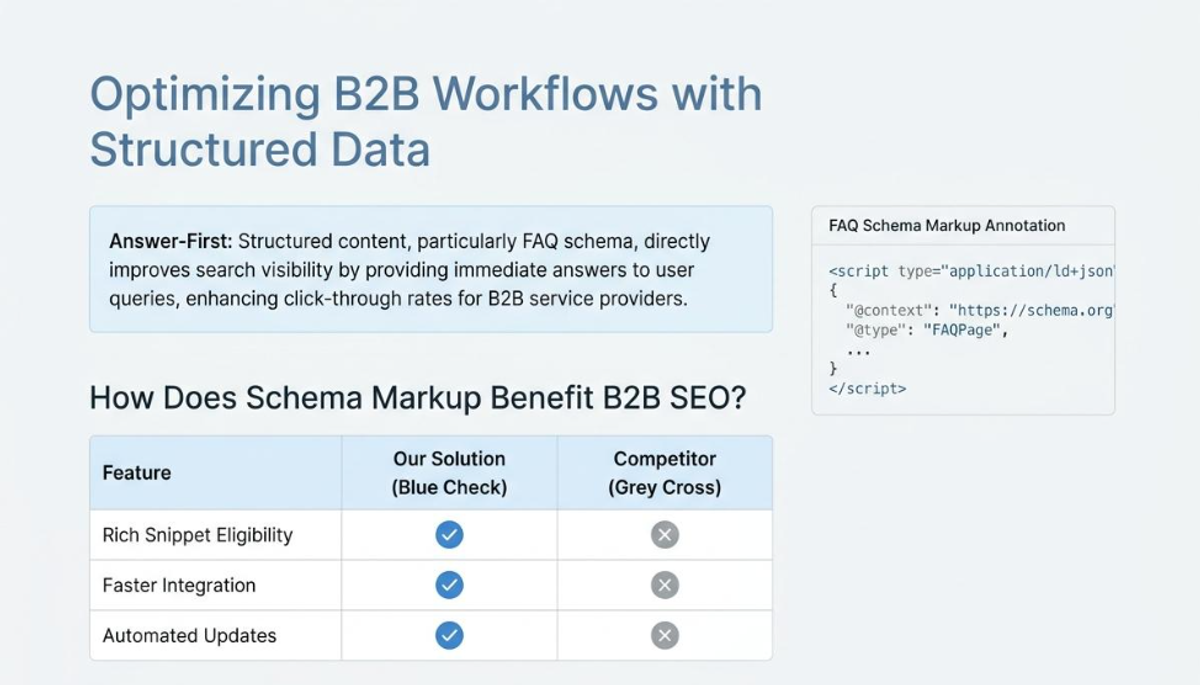
Tactic 3 is answer-first paragraph structure. Open every section with a 100-150 word direct answer to the question the heading poses. Follow that answer with supporting detail, evidence, and nuance. This mirrors how AI engines extract content - they pull the most direct answer first. Use clear H2/H3 hierarchies, short paragraphs, numbered steps where sequence matters, and comparison tables where side-by-side data is more useful than prose.
Tactic 4 is schema markup. FAQPage, HowTo, QAPage, and Organization schema are the four most valuable implementations for B2B. Definition blocks with schema markup are among the highest-value structural patterns for AI extractability. These schema types signal to AI systems that content is organized, verifiable, and machine-readable.
Shana Murik at Future B2B frames content structure as the foundation of editorial credibility: “Our editorial ecosystem ensures that content is relevant and trustworthy, which is critical for brands seeking to be cited and surfaced in AI-generated responses.” Structure isn’t just a technical optimization - it’s a trust signal.
Content structuring checklist for B2B teams: maintain “last updated” dates on all pages, use bullet points for parallel items, include comparison tables for competitive content, write H2s as questions buyers actually ask, and keep intro paragraphs under 150 words before the first substantive point.
Create content that earns AI citations through authority
Tactic 5 - Publish original research and named frameworks. Tactic 6 - Invest in digital PR targeting the outlets AI actually cites.
AI models don’t cite everything - they cite what they trust, and trust is built through a narrow set of high-value content signals. Enoch Pakanati at The Smarketers identifies four content types that generate the highest information gain for AI systems: proprietary data, expert quotes with attribution, frameworks with distinctive names, and contrarian positions. These are also the four hardest content types for competitors to replicate, which is why brands that produce them consistently build durable AI authority rather than volatile citation patterns.
The Share of Model metric - citation percentage across target queries - is the north-star measurement for this work. The Smarketers documented a case where moving from 60 to 280+ external mentions increased Share of Model on five target queries from 8% to 41% within seven months. That’s the compounding effect of earned authority in AI systems: each new citation reinforces the model’s pattern of citing you, which increases the probability of future citations.
Tactic 5 is to publish original research, proprietary benchmarks, or named frameworks every quarter. This doesn’t require a large research budget. Internal data - customer success rates, usage patterns, implementation timelines - becomes original research when aggregated and published. Named frameworks (even simple ones) give AI systems a citable concept with a clear origin, which is exactly the kind of attribution signal they favor. If your framework has a name and you coined it, it gets attributed to you.
Tactic 6 is digital PR targeted at the outlets AI systems actually cite for your category. Dan Stillgoe’s audit finding is worth taking seriously: roughly five dominant citation sources control each topic area. Getting into those sources - through contributed articles, expert quotes, or product coverage - is more valuable than publishing the same content independently on your own domain. Brands in the top quartile for fresh, updated web mentions receive 10x more AI citations than brands with stale or infrequent coverage. Freshness and breadth of citation sources both matter.
The biggest aeo b2b marketing strategy changes show up in how authority is built. The old playbook was: rank for keywords, earn backlinks, repeat. The new playbook adds: earn citations from the sources AI trusts, keep those citations fresh, and measure Share of Model, not just rankings.
Leverage customers and stakeholder voices for AI discoverability
Tactic 7 - Refresh customer content for AI discoverability. Tactic 8 - Build role-based content for multi-stakeholder buying teams.
Amy Bills, VP Principal Analyst at Forrester, argues that the most overlooked asset in any B2B company’s AEO strategy is its own customer base. Her reasoning: “AI systems favor original, expert-driven, human-authored material” - and customer testimonials, case studies, and third-party reviews are exactly that. They’re human-authored, experience-based, and independently validated. “If your customers are showing up, you are, too,” Bills notes, describing how AI-generated answers surface company information through customer-generated content.
Forrester found that 94% of B2B buyers use AI in purchasing decisions, and 76% of B2B decision-makers who contribute content have already created new guidelines to support quality as generative AI adoption increases. The buyers themselves are changing how they engage with AI - and the vendors whose customers show up in those conversations have a structural advantage.
Tactic 7 is a systematic refresh of your existing customer content. Update testimonials with specific outcome metrics - not “we saw improvement” but “we reduced onboarding time by 40% in the first 90 days.” Rewrite case studies in the language your buyers actually use when querying AI, not your internal product terminology. Match customer content to the platforms where it gets discovered: LinkedIn for professional context, Reddit threads for candid practitioner discussion, industry-specific forums for technical credibility, video for complex implementations.
How is aeo changing b2b marketing strategy? Nowhere more clearly than in the multi-stakeholder buying process. Reveation Labs found that 79% of B2B purchases have the CFO holding final decision-making power, yet most B2B content is written for a single generalized buyer persona. Buyers use 37-120+ prompt variations when querying AI systems, and those variations shift dramatically depending on the stakeholder’s role and concern.
Tactic 8 is role-based answer segmentation. Build content that addresses distinct stakeholder concerns: ROI timelines and cost reduction for CFOs, security architecture and integration complexity for IT, vendor stability and contract terms for procurement, onboarding speed and daily usability for end users. Each of these audiences queries AI with different language and expects different answers. If your content only addresses one, you’re winning one stakeholder and losing the committee.
The practical implication: for each major content piece, ask which role is searching this question and what specifically do they need to see to move forward. That question shapes everything from the title to the specific data points you include.
Measure AI presence and build a compounding AEO system
Tactic 9 - Manage brand entities for semantic consistency. Tactic 10 - Treat AEO as an ongoing operational loop, not a campaign.
Dan Stillgoe’s most important finding from 25 B2B AEO audits isn’t tactical - it’s structural. “Consistent presence across a topic, not one-off wins” is the actual objective. Traditional rankings can be achieved with a single well-optimized piece. AI citation share requires sustained presence across a cluster of related prompts, maintained over time. That’s a fundamentally different operational model.
Zoe Ashbridge of HubSpot documents the measurement framework: track traffic from AI sources, conversion rates from AI-referred visitors, brand sentiment in AI responses, citation accuracy, and competitive share of voice across ChatGPT, Perplexity, and Gemini. One B2B client in HubSpot’s research converted AI referral traffic at 7.12% versus 1.37% from traditional organic search - a 5x conversion rate difference that makes the business case for AEO investment concrete. The 32% of B2B buyers who discover new vendors using generative AI chatbots are converting at rates traditional SEO hasn’t seen in years.
Tactic 9 is entity management. AI systems understand brands through entity relationships, not just keyword matching. Define and manage your brand entities consistently using what HubSpot calls Semantic Triples - Subject-Predicate-Object relationships that establish clear, machine-readable associations between your company, your products, and the problems you solve. “Acme Software reduces enterprise onboarding time by 40%” is a Semantic Triple. Consistent use of this structure across your content helps AI systems accurately understand and cite your brand the way you’d describe it yourself.
The misinformation risk of ignoring entity management is real. Ashbridge documents a case where a B2B catering company’s pricing appeared in Google AI Mode pulled from a Reddit thread, showing figures 195% below actual cost. The company had no authoritative content defining its own pricing - so AI filled the gap with whatever it could find. Uncontrolled entity narratives get filled by others.
Tactic 10 is building an ongoing operational cadence rather than running AEO as a campaign. Practitioners in r/AskMarketing’s thread on AEO strategies consistently identify the same pattern: teams that run a one-time AEO audit and content push see short-term citation gains that erode within two to three quarters. Sustained presence requires a quarterly content refresh cycle - updating case studies with new results, refreshing pricing pages with current data, rewriting comparison content as competitors evolve - plus monthly prompt performance reviews using tools like Scrunch or custom GA4 channel groups.
The aeo strategy for b2b brands that compounds over time shares one characteristic: they treat AI visibility as an ongoing channel with its own operational rhythm, not as an SEO optimization project with a defined end date.
Build your AI presence before the shortlist closes
The window to build early AI presence in most B2B categories is still open - but not for long. Reveation Labs tracked early AEO adopters achieving 287-415% ROI within 90-120 days, and 25x higher conversion rates from AI-sourced traffic compared to traditional organic search. Those aren’t sustainable advantages - they’re first-mover returns that compress as more competitors enter the channel.
The core aeo strategy for b2b in 2026 comes down to ten tactics that reinforce each other: audit your current AI visibility and build measurement infrastructure, structure content for AI extraction with answer-first formatting and schema markup, earn citations through original research and targeted digital PR, leverage customer voices and build role-based content for buying committees, and manage brand entities while running a sustained operational cadence.
What Forrester’s Amy Bills calls the most overlooked AEO asset - your own customers - is also your most defensible one. Competitor content can be matched. Customer experience can’t be fabricated.
The aeo strategy for b2b brands that will dominate AI search in 2026 isn’t about hacking algorithm signals. It’s about giving AI systems so much accurate, well-structured, externally-validated information about your brand that they have no reason to cite anyone else. That’s not a campaign. It’s how you build a company that AI recommends before buyers know your name.
Frequently Asked Questions
What is AEO and why does it matter for B2B companies?
Answer Engine Optimization (AEO) is the practice of structuring content so that AI-powered answer engines like ChatGPT, Perplexity, and Google AI Overviews cite your brand in their responses. For B2B companies, AEO matters because enterprise buyers increasingly use AI tools during research and vendor evaluation. According to Forrester, 94% of B2B buyers now use AI assistants as part of their purchase research process.
How is AEO different from traditional SEO for B2B?
Traditional B2B SEO targets search engine rankings through keyword optimization and backlinks, driving traffic to your site. AEO targets AI-generated answers directly, aiming for your brand to be cited as a trusted source rather than just ranked in a list of links. AEO requires building topical authority, structured content, and third-party citations rather than optimizing meta tags and anchor text.
How do B2B companies implement an AEO strategy?
A B2B AEO strategy starts with mapping buyer questions across the full purchase journey, then creating content that directly answers those questions with named expert sources and specific data. Structure every page with clear H2 headings that match question formats, include FAQ sections, add schema markup, and earn coverage in industry publications and analyst reports that AI models use as training signals.
What types of B2B content perform best in AI search?
B2B content that performs best in AI search includes technical guides that answer specific product or process questions, comparison articles that address 'X vs Y' buyer queries, data-backed thought leadership with original research, customer case studies with measurable outcomes, and FAQ pages that address common sales objections. Content written by named subject matter experts with industry credentials receives higher citation rates from AI systems.
How does AEO change B2B marketing strategy in 2026?
AEO shifts B2B marketing from traffic-first to authority-first. Instead of optimizing for click-through rates on search listings, teams now optimize for citation frequency in AI responses. This means publishing fewer, deeper content pieces rather than high-volume thin content, investing in analyst relationships and third-party coverage, and measuring brand presence in AI answers alongside traditional web analytics.
How do you measure AEO success for B2B brands?
Key AEO metrics for B2B include AI citation rate (how often your brand appears in AI responses to relevant queries), share of AI voice (your citations versus competitors), referral traffic from AI platforms in Google Analytics 4, and pipeline influence attributed to AI-assisted research sessions. Tools like Profound, Otterly.AI, and SE Ranking's AI tracking features can automate monitoring across ChatGPT, Perplexity, and Google AI Overviews.