ChatGPT handles over 2 billion queries every single day. That number, reported by Frase.io’s complete AEO guide, isn’t a projection - it’s the current reality. Meanwhile, 58.5% of Google searches now end without anyone clicking a result, because AI Overviews answer the question before the user needs to go anywhere. And here’s the tension worth sitting with: AI-referred visitors, when they do land on your site, convert at 4.4 times the rate of standard organic visitors and spend 68% more time on page.
The platforms doing the answering - ChatGPT, Perplexity, Google AI Mode, Microsoft Copilot - are selecting their sources deliberately. They’re not just pulling the highest-ranking pages. According to Frase.io’s research across 17 million analyzed citations, only 38% of AI Overview citations come from pages already sitting in Google’s top 10. AI diversifies. It rewards content structured to answer questions, not just content that has historically ranked well.
That’s what answer engine optimization is: the practice of structuring your content so AI-powered platforms select and cite it when generating responses. Unlike traditional SEO, which operates at the page level, AEO operates at the fact level. Individual segments get retrieved, evaluated for authority, and assembled into answers. Your page can contribute to dozens of different AI responses if it’s built correctly.
The best tips for answer engine optimization in AI aren’t complicated in theory. But most organizations aren’t acting on them yet. Frase.io puts current adoption at just 20%, leaving a 70% gap that’s still wide open. This article covers what you actually need to know - from how AI systems parse content to which metrics tell you whether your AEO strategy is working. These answer engine optimization ai tips are drawn from practitioner research, analyst frameworks, and documented case results.

How AI answer engines actually parse and select content
You can’t optimize for a system you don’t fully understand. Most content teams approach AEO as if it were SEO with extra steps - they optimize titles, add keywords, build a few backlinks, and call it done. That approach misses something fundamental about how these systems work.
The underlying architecture for most AI search platforms involves Retrieval-Augmented Generation, or RAG. When a user submits a query, the system interprets the intent, retrieves relevant content segments from its index, ranks those segments for authority and relevance, and then generates a response that assembles pieces from multiple sources. Your article doesn’t get cited wholesale - specific paragraphs, sentences, or data points get extracted and used.
Microsoft Advertising made this explicit in their October 2025 post on optimizing content for AI search answers. They describe what they call the “parsing model”: AI breaks content into modular segments, evaluating each one independently for authority and relevance before assembling them into a response. The implication is significant. A single well-structured page can contribute to dozens of different AI answers across dozens of different topics, as long as each section stands alone as a coherent, authoritative statement.
This is why average prompt length matters. Community research cited work puts the average ChatGPT prompt at 23 words, compared to 3.37 words for a traditional Google search query. Users are asking questions in full sentences. “What’s the best CRM for a 10-person sales team?” not just “CRM software.” Content that mirrors natural conversational phrasing gets parsed and retrieved more accurately than content written around short-tail keyword phrases.
Platform differences are real and worth accounting for. Frase.io’s citation research breaks it down clearly: ChatGPT favors authoritative long-form content, Perplexity favors fresh and well-cited articles, and Google AI Overviews still lean toward pages already ranking organically. Currently, 87.4% of AI referral traffic comes from ChatGPT - but that share is actively shifting as Perplexity and Google AI Mode grow.
Forrester frames this accurately in their AEO mastery blog: the discipline is also called generative engine optimization, AI optimization, and LLM optimization, depending on who you ask. All of them describe the same retrieval layer. And as Forrester notes, 94% of B2B buyers now use AI tools in their purchasing decisions - which makes this less a forward-looking strategy and more a present-tense requirement for competitive B2B brands.
The best tips for answer engine optimization ai aren’t separate from understanding the mechanics. Structure choices, technical decisions, and authority-building all flow from knowing that AI sees your content as a collection of retrievable segments, not a unified page.
Structuring content for AI extraction
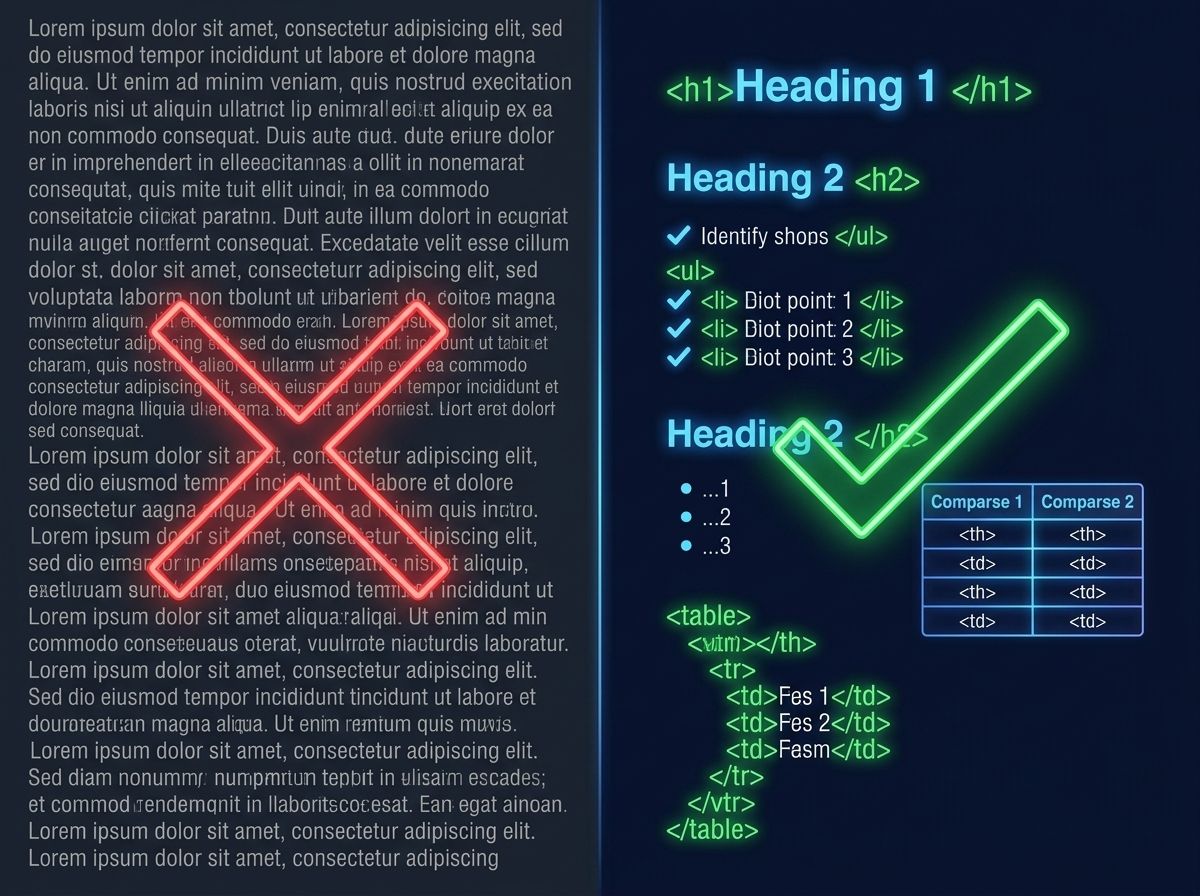
AI can only cite what it can parse. Structure is the primary extraction signal - more important, in many cases, than the quality of the underlying writing. A brilliant insight buried inside a 600-word paragraph with no heading will get ignored. A mediocre point stated clearly in a two-sentence answer block with a descriptive H2 above it will get cited.
These aeo answer engine optimization tips on structure apply regardless of which platform you’re optimizing for.
Start with the answer, then build the case. HubSpot’s AEO guide is direct about this: “Put your core answer in the first 40-60 words before adding detail.” Frase.io’s six-step AEO framework makes the same point as its first principle. Lead with the answer, then support it. This is the inverted pyramid structure familiar from journalism, applied to content marketing. Frame definitions using the pattern “[Term] is [clear definition]” - it’s extractable, quotable, and recognizable to AI parsers as definitional content.
Use headings that describe what the section answers. Generic headings like “Background” or “Overview” give AI crawlers nothing to work with. Question-format headings - “What is answer engine optimization?” or “How do you implement FAQPage schema?” - map directly to query structures. When a user asks that exact question, your section is aligned.
Keep sections between 200 and 400 words with clear semantic boundaries. Frase.io recommends this range specifically. Shorter than 200 words and there may not be enough substance; longer than 400 and you risk the section becoming unscannable for AI parsers trying to identify the core claim.
Use bullets, numbered lists, and comparison tables. Microsoft’s October 2025 guidance explicitly endorses these formats for complex information. They’re modular by nature - each bullet is a self-contained claim that can be extracted independently.
Write self-contained sentences. Microsoft makes this point precisely: prioritize concise, self-contained answers of 1-2 sentences that can be extracted and understood without the surrounding context. If you write a sentence that only makes sense with the three sentences before it, it can’t be cited cleanly.
The flip side - what actively hurts extraction - is equally instructive. Microsoft flags four common mistakes that block AI citation:
- ·Long, unstructured text blocks that obscure idea separation
- ·Content hidden inside tabs or expandable menus, which AI crawlers may not render
- ·PDFs, which lack the structural signals HTML provides
- ·Critical information embedded only in images, which reduces parsing accuracy
Forrester adds a technical layer: minimizing JavaScript rendering matters because AEO crawlers retrieve content in real-time and become overloaded when they have to render complex JS just to access basic page text. If your most important content lives behind a JavaScript call, it’s effectively invisible to AI indexing.
Microsoft Advertising’s October 2025 data gives this structural discipline a stakes-level context: AI referrals to top websites grew 357% year-over-year, with AI systems handling 1.13 billion visits in June 2025. The brands capturing those referrals are the ones that structure content in modular, extractable blocks. The brands that don’t are watching that traffic go to competitors who do.
These answer engine optimization tips ai practitioners keep returning to aren’t about writing worse content - they’re about making good content accessible to the systems doing the selecting.
Building topical authority and citation signals
Single-page optimization won’t get you cited consistently. AI systems develop an implicit authority model for sources - they learn which sites reliably answer questions on specific topics, and they favor those sites when assembling responses. A brand that has one great article and nothing around it will get cited occasionally, by luck. A brand with a pillar page supported by a cluster of relevant subtopic articles gets cited because the AI associates it with expertise on that topic.
These answer engine optimization ai visibility tips on authority apply to brands at any scale.
Build pillar plus cluster architecture. Frase.io’s framework makes this a dedicated principle: create pillar content covering your core topic comprehensively, then support it with cluster articles on subtopics. Interlink the clusters using descriptive anchor text. Critically - cover subtopics that competitors miss. Identify those gaps by running manual queries across ChatGPT and Perplexity and noting where AI says “there isn’t much coverage on this.” That’s your opening.
Anticipate follow-up questions. Forrester’s AEO blog makes an observation worth quoting directly: “Answer engines recognize and reward content that answers several questions and anticipates follow-ups.” This means mapping the full buyer journey - awareness, consideration, decision - and creating dedicated content for each phase. It also means that when you write about a topic, you should ask yourself: what would someone logically ask next? Then answer that, too, either in the same article or in a linked cluster piece.
Content freshness is not cosmetic. Frase.io’s analysis found that AI-surfaced URLs are 25.7% fresher than traditional search results. Recency is an active ranking signal, not a tiebreaker. Establish a quarterly refresh cycle: update statistics, swap out dated examples, change publication dates to reflect the update. This matters more for fast-moving topics like AI tools and technology, but applies across almost every vertical.
Your answer engine optimization aeo tips strategy needs community presence. Research found that domains with millions of brand mentions on Quora and Reddit have roughly four times higher chances of being cited by AI systems than those with minimal community presence. This isn’t a soft trust factor - it’s a measurable citation signal. HubSpot’s AEO guide recommends publishing authentically on LinkedIn, Reddit, and industry outlets as part of a sustained trust-building effort. Earned mentions in high-authority publications feed the corpus that AI models draw from. Brands that treat community engagement as optional are leaving a 4x citation multiplier on the table.
Entity clarity reinforces authority signals. Define key terms when you introduce them, use consistent terminology throughout your content, and always refer to your brand by its official name. Link out to authoritative external sources - Wikipedia, government sites, peer-reviewed research - to signal semantic trustworthiness. Google’s Knowledge Graph alone contains 500 billion facts about 5 billion entities. When your content connects cleanly to recognized entities, it plugs into that graph and benefits from the associations.
Original data earns disproportionate citation. AI systems cite data they can’t find elsewhere. Proprietary surveys, internal benchmarks, original research - these become magnets for citation because they’re the only source for that specific number. If you have the capacity to produce original research, even small-scale studies, prioritize it.
Schema markup and technical AEO signals
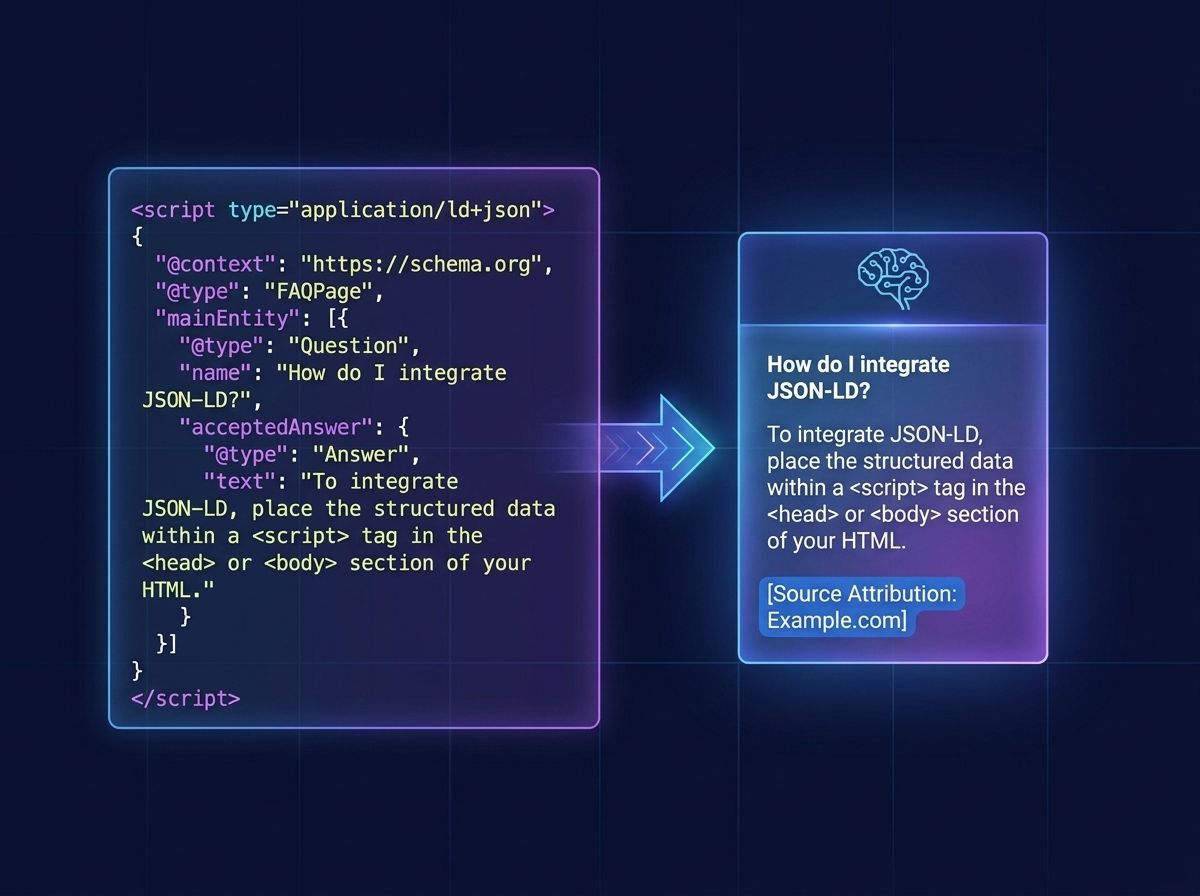
Schema markup is the clearest direct signal you can give AI crawlers. It doesn’t just describe what your content says - it tells AI systems what type of content they’re looking at, who wrote it, when it was published, and what questions it answers. For aeo answer engine optimization tips for brands building serious AEO programs, schema is non-negotiable infrastructure.
Frase.io identifies FAQPage schema as the highest-impact quick win in AEO implementation. The reason is mechanical: FAQPage schema extracts question-and-answer pairs directly into a structured format that AI systems can retrieve and cite with high confidence. Every FAQ section on your site should have it. The technical lift is low relative to the citation benefit.
The other schema types worth prioritizing, in rough order of impact:
- ·Article/BlogPosting schema - identifies content type, author name, and publication date. The publication date functions as a freshness signal; author attribution builds E-E-A-T trust indicators.
- ·HowTo schema - for any process-oriented content, this structures steps in a retrievable format.
- ·Product/Review schema - for commercial content, this helps AI distinguish product pages from editorial content.
- ·BreadcrumbList schema - shows topical hierarchy to crawlers, reinforcing that your content sits within an organized topical structure.
All of this should be implemented in JSON-LD format. Microsoft’s October 2025 guidance specifically recommends JSON-LD with schema.org types for classifying content as products, reviews, FAQs, and events.
Beyond schema, trust signals visible on the page itself matter. HubSpot’s AEO guide recommends displaying author names, credentials, and update dates prominently. Highlight quotable statistics and definitions - put them in a callout block or bold text so they’re visually and structurally distinct. Maintain consistent messaging across all channels, because AI systems cross-reference claims from multiple sources and inconsistencies undermine authority.
The crawlability baseline: make sure all important content is accessible without authentication or login walls (HubSpot). Minimize JavaScript rendering for critical content (Forrester). Don’t hide anything useful inside expandable menus or tabs (Microsoft). Use HTML, not PDFs, for any content you want indexed (Microsoft).
The business case for doing all of this isn’t abstract. HubSpot’s own AEO implementation produced a 1,850% increase in qualified leads. Their beta AEO customers drove 20% more traffic from AI sources than non-users. Sandler, the sales training firm, generated roughly 8,000 new website visitors and lifted their Brand Visibility Score by two percentage points within weeks of implementing structured AEO practices. These outcomes trace back to schema, structure, and trust signals working together.
HubSpot notes that 42% of CRM software buyers now use AI search during their product evaluation - and AI-referred traffic converts at 3 times higher rates than traditional search. Schema markup and technical AEO signals are how you make sure those buyers find you, not a competitor.
Measuring AEO success - from rankings to citation tracking
Traditional SEO metrics don’t transfer cleanly to AEO. Ranking position doesn’t tell you whether you’re being cited by ChatGPT. Organic traffic doesn’t capture visitors arriving via Perplexity. Average position is irrelevant when the answer engine doesn’t show positions. Brands that measure their AEO performance with legacy SEO dashboards are flying blind.
These aeo answer engine optimization tips 2026 on measurement apply whether you’re just starting your AEO program or trying to mature an existing one.
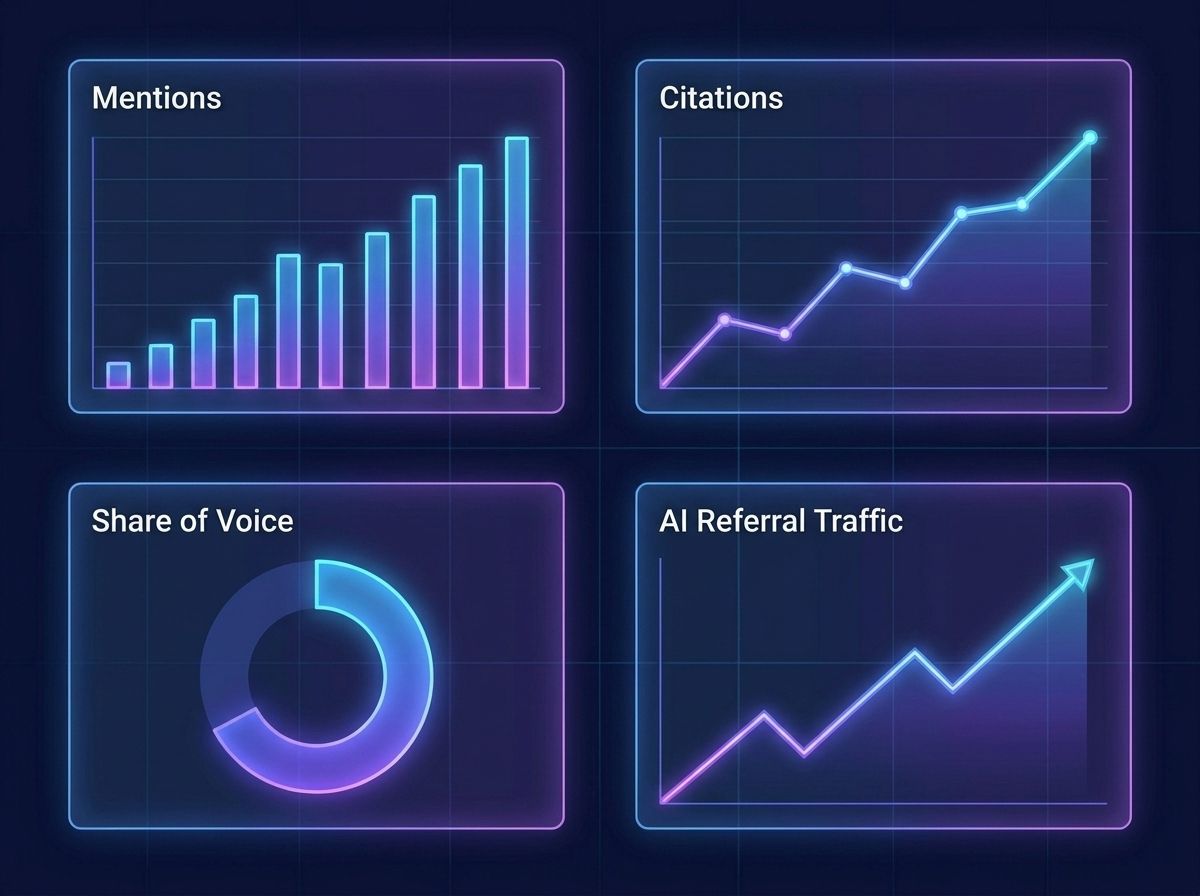
HubSpot’s AEO guide defines four metrics that actually matter:
- 1.Mentions - how often your brand appears in AI-generated answers, with or without a link
- 2.Citations - how many of those mentions include a clickable link back to your site
- 3.Share of Voice - your mention rate versus your competitors within a specific topic or category
- 4.AI Referral Traffic - actual visitors arriving from answer engines, trackable in Google Analytics 4 by filtering for sources like chat.openai.com, perplexity.ai, and bing.com/chat
Forrester’s measurement framework shifts the orientation further: move away from rankings, average position, and raw organic traffic as primary indicators. Focus instead on answer engine results page saturation and share of search. Score your visibility for topics associated with your brand to find content gaps - which topics do competitors get cited for that you don’t?
For practical setup, Frase.io recommends establishing a baseline by documenting citation frequency across 10 to 20 core queries on a monthly basis. Run those queries manually across ChatGPT, Perplexity, and Google AI Mode. Record which of your pages are being cited, which aren’t, and who’s getting cited instead of you on topics you should own.
Tools built specifically for AEO tracking have emerged to handle this at scale. The practitioner community has coalesced around several options: Otterly.AI, which starts at $29 per month and tracks prompts across four-plus AI models; Profound, which reports on actual prompt volumes from ChatGPT, Perplexity, Gemini, and Claude; which connects AEO and SEO workflows in one platform; AIclicks, which offers a Citation Intelligence feature; and Visiblie, which runs daily tracking across eight AI models. Daily AI search users in the US nearly doubled from 14% in February 2025 to 29.2% by August 2025, according to community research - the tools are keeping pace with that growth.
The iteration cycle that works: quarterly content refresh to update statistics and dates, monthly citation audits to identify which pages are and aren’t getting cited, and platform-specific adjustments based on citation behavior differences between ChatGPT, Perplexity, and Google AI Mode.
Forrester makes a point that’s easy to miss in the execution: AEO improvement requires coordinating content, IT, social, and paid media teams. It’s not a solo SEO project. The brands seeing the biggest visibility gains are treating it as a cross-functional discipline.
AI referral traffic grows at approximately 1% month over month, doubling roughly every quarter, according to Frase.io’s data. The aeo answer engine optimization guide tips 2026 for measurement all point toward the same conclusion: establish your tracking infrastructure now, while the compounding is still early.
What to do with all of this
Let’s be direct about where things stand. Forrester found that 94% of B2B buyers now use AI in purchasing decisions. Microsoft Advertising reported 357% year-over-year growth in AI referrals in just one year. Frase.io’s data shows AI-referred visitors converting at 4.4 times the rate of standard organic visitors. The platforms are dominant, the traffic is converting, and the brands being cited are building an accelerating advantage.
And yet only 20% of organizations have started AEO implementation. That gap is the opportunity.
The five areas covered in this article aren’t a wish list - they’re a sequence. Understand the parsing model first. Then structure content for extraction, because no amount of topical authority matters if your content blocks are unreadable to AI crawlers. Build authority through pillar architecture, content freshness, and community presence. Implement schema markup as infrastructure, not an afterthought. And measure with AEO-specific metrics from day one, so you know what’s working.
HubSpot is direct about something important: AEO can’t be treated as a one-time project. It’s an ongoing practice of auditing content, tracking citation performance, and structuring new assets with answer engines in mind. That’s not a warning - it’s an advantage for brands willing to build the habit.
The best tips for answer engine optimization in AI aren’t secrets. They’re principles that follow logically from how these systems work. The brands applying them consistently right now, while the 70% adoption gap is still open, are the ones that will own their category’s AI citations as this becomes standard practice in 2026. Answer engine optimization aeo tips 2026 aren’t about predicting what’s coming - they’re about acting on what’s already here.
What are the most important AEO ranking factors?
The most impactful AEO factors are: FAQPage and Article schema markup, allowing AI crawlers in robots.txt, domain authority above 40, original research or proprietary data, named authors with verifiable credentials, direct answers in the first 100 words of content, and content updated within the last 6 months. Sites with all seven factors have significantly higher AI citation rates.
How long does AEO take to show results?
Initial AEO improvements - schema markup, robots.txt fixes, content restructuring - can show citation results within 2-4 weeks for queries where you are already a credible source. Authority-building strategies like entity recognition and press mentions take 3-6 months to register meaningfully. Tracking AI citation frequency monthly against a baseline of target queries is the most reliable measurement method.
Is AEO the same as voice search optimization?
No. Voice search optimization focuses on conversational queries answered by smart speakers (Alexa, Siri). AEO focuses on getting cited in text-based AI answer engines like ChatGPT, Perplexity, and Google AI Overviews. While both reward direct-answer content structure, AEO also requires structured data schema, entity signals, and AI crawler access -elements not relevant to voice search.