Over 300 million people use ChatGPT every week. That’s not a rounding error. It’s a platform larger than most countries. And yet, most SEOs I talk to are either using it wrong, expecting too much, or ignoring it entirely because they got burned once by a hallucinated statistic.
This guide is about using ChatGPT for SEO in a way that actually moves rankings - not just in Google, but increasingly in ChatGPT’s own search results, which are 73% similar to Bing’s. That second part matters more than most people realize.
Here’s the honest truth about ChatGPT as an SEO tool: it’s fast, it’s versatile, and it’s genuinely useful for a dozen specific tasks. It’s also wrong with alarming regularity, frozen at an April 2023 knowledge cutoff, and completely blind to real-time search volume data. “Human oversight remains essential for quality SEO work.” That’s not a disclaimer. It’s a workflow requirement.
What this guide gives you is the full picture. What ChatGPT can do well for SEO. Where it falls apart. A framework for building it into your workflow without introducing junk into your content. And 39 tested prompts organized by task - more than any other resource I’ve found on the topic.
Whether you’re an in-house SEO trying to scale content production, a freelancer managing multiple clients, or someone just starting out with keyword research, the practical answer to the question “can you use ChatGPT for SEO?” is: yes, with conditions. Those conditions are what this guide is about.
The SEO landscape is changing fast. AI search isn’t replacing Google overnight, data puts ChatGPT at roughly 2% of Google’s traffic volume while Google maintains over 91% market share. But optimizing for AI visibility is becoming a separate discipline worth taking seriously. By the end of this guide, you’ll know how to do both.
What ChatGPT can and cannot do for SEO
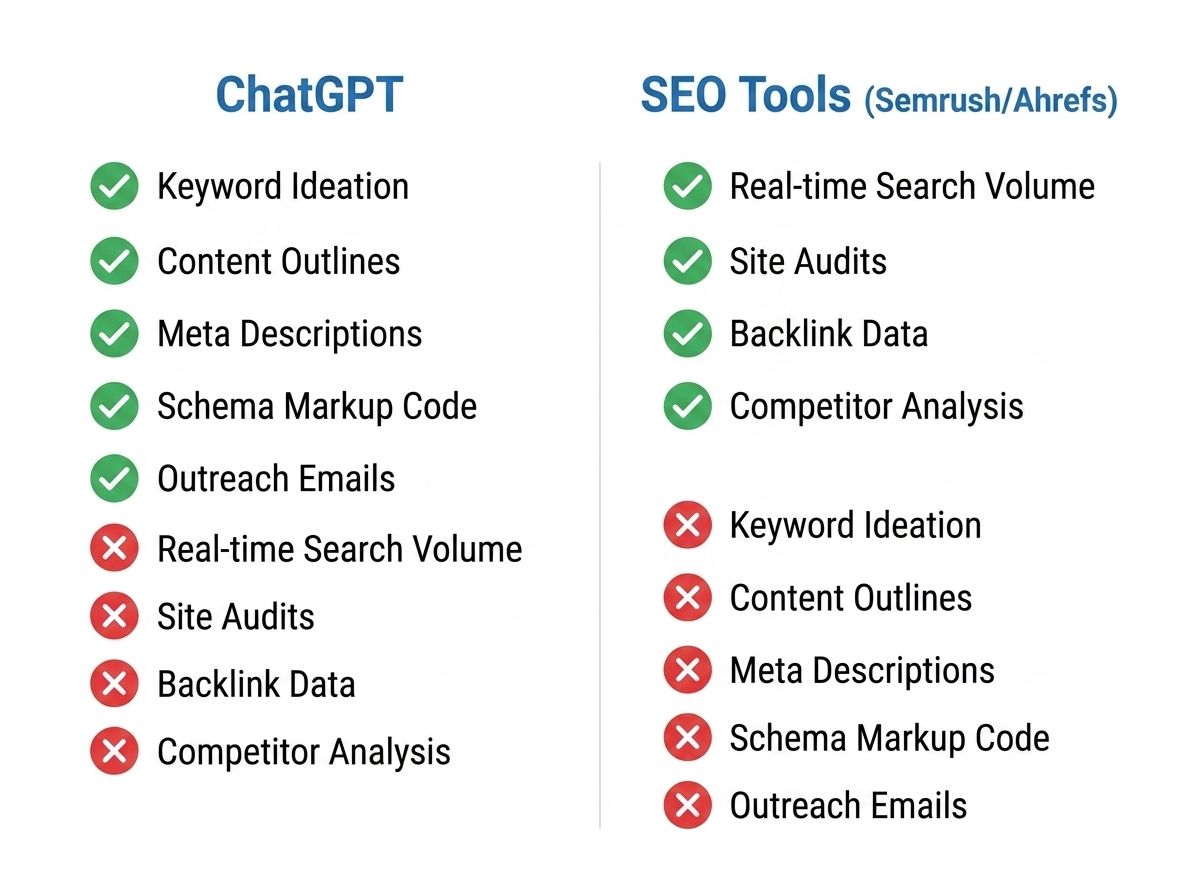
The five ways ChatGPT powers modern SEO workflows
Let’s start with what actually works, because the list is genuinely useful and often undersold.
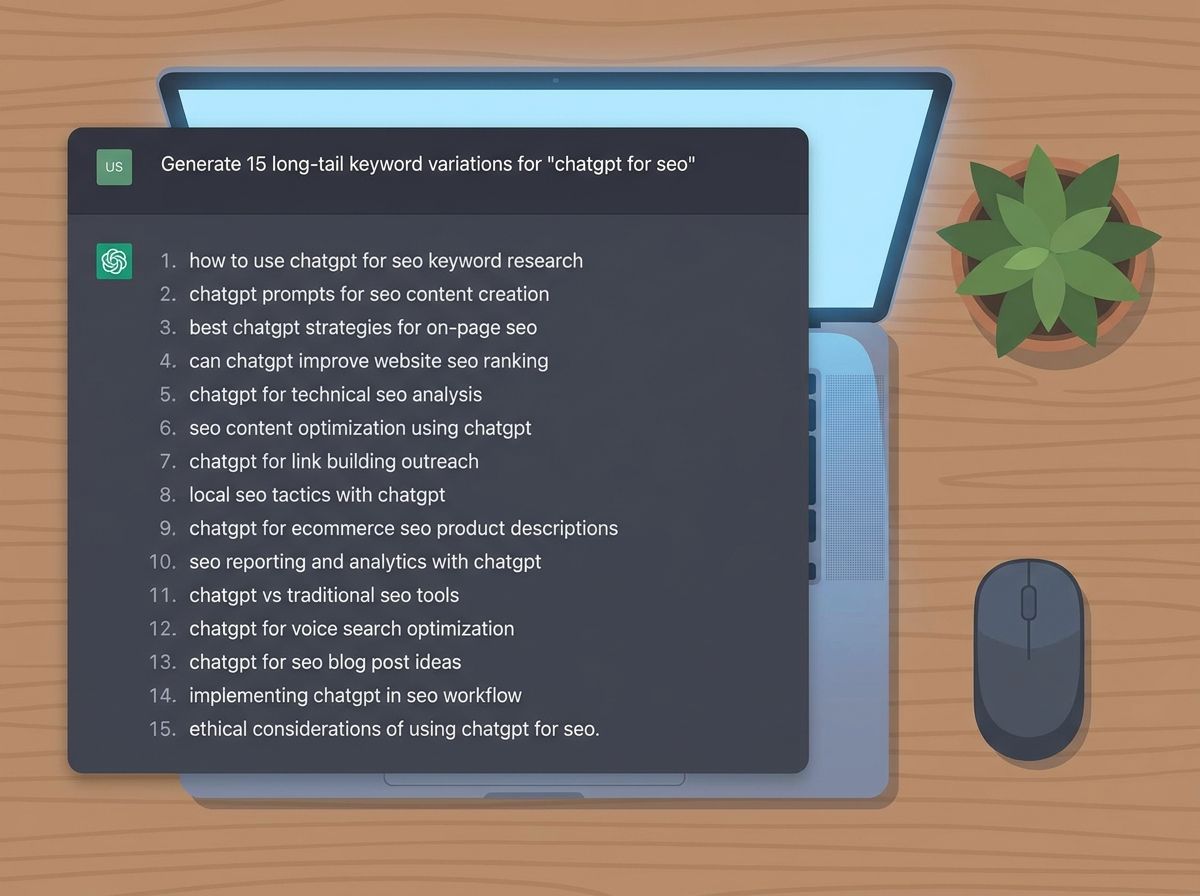
Keyword research acceleration. ChatGPT won’t give you search volume numbers; that requires Semrush, Ahrefs, or Google Keyword Planner. But it’s excellent at generating semantic keyword clusters, long-tail variations, and topic maps faster than any manual process. You give it a seed term, it generates 20-30 related phrases, and you run those through your actual tool. The ideation step shrinks from 30 minutes to 5.
Content structuring. This is where I think ChatGPT earns its place most clearly. Feed it a target keyword and it produces a solid H2/H3 outline covering the topic from multiple angles. It’s not always right about what searchers want, but it’s a strong starting point that you can validate against actual SERPs. B
Meta tag generation at scale. Writing 50 meta descriptions for an e-commerce site is tedious work that ChatGPT handles well. The output needs editing (it leans toward generic phrasing by default), but the structure is there and the keyword placement is reliable when you specify it clearly in your prompt.
Technical SEO guidance. This surprised me when I first tested it. ChatGPT generates valid robots.txt configurations, correct hreflang syntax, schema markup in JSON-LD format, and even .htaccess redirect rules when you give it the source/destination URL list. It doesn’t replace a technical audit, but for implementation, it’s a solid code generator.
Link-building and outreach support. Drafting HARO responses, generating anchor text variations, identifying content gaps by analyzing competitor topics: ChatGPT handles all of these competently. The copy still needs a human voice injection, but the scaffolding is there.
The hard limits: what ChatGPT cannot do
Understanding the ceiling matters as much as knowing the floor.
Knowledge cutoff at April 2023. This isn’t a minor inconvenience. It means ChatGPT has no idea what changed in Google’s algorithm after that date. Core updates, new ranking signals, shifts in SERP layout - none of it. For evergreen content, this is manageable. For anything time-sensitive or trend-based, it’s a real problem.
No real-time search volume data. ChatGPT will happily tell you a keyword “probably gets moderate search volume” or is “likely competitive.” Those are guesses dressed up as analysis. You need actual tools for this.
Hallucinations. This is the one that will bite you if you’re not careful. ChatGPT generates plausible-sounding content with confidence, even when the underlying facts are invented. Statistics, quotes, study citations - it fabricates all of these convincingly. Every data point in ChatGPT output needs independent verification before it goes near a published page.
Can’t replace SEO tools. ChatGPT cannot run site audits, pull competitor backlink profiles, check Core Web Vitals, or provide crawl data. It’s a language model, not an analytics platform. The community discussion on OpenAI’s forums reflects this reality too. Users who’ve tried using ChatGPT as a primary SEO tool report that it handles creative and structural tasks well, but fails badly as a data source.
Writing quality without human input. WordStream makes the case plainly: “ChatGPT alone cannot generate content that adheres to SEO guidelines, exhibits creativity, or embodies your unique voice.” That’s not pessimism. It’s an accurate assessment of the output quality when prompts are generic. Robotic phrasing, overused structures, and lack of original perspective are consistent problems in raw ChatGPT output.
The OpenAI community forum discussion on ChatGPT and SEO captured the polarized reality: some users reported severe organic traffic drops after Google’s March 2023 core update when publishing unedited AI content at scale. Others managing large portfolios of AI-assisted content maintained strong rankings. The difference, consistently, was content quality and editorial oversight.
Reddit’s r/SEO community debates ChatGPT effectiveness regularly and lands in a similar place: the tool is genuinely useful for workflow acceleration and specific tasks, but over-reliance without human editorial oversight produces content that underperforms. The consensus leans toward using ChatGPT as a starting point, not a finishing line.
Practical ChatGPT use cases for SEO success
Keyword research and content planning
Here’s a concrete workflow that works. Start with a broad topic - say, “email marketing for e-commerce.” Ask ChatGPT to generate 30 semantically related topics under that category. You’ll get a mix of beginner and advanced angles, some obvious, some not. From that list, you pull 10-15 that look viable and run them through Semrush or Ahrefs to check actual search volume and difficulty.
The value ChatGPT adds in this step isn’t the keyword data. It’s the breadth of ideation. A human doing this manually might hit 8-10 topics in 20 minutes. ChatGPT generates 30 in 30 seconds. The filtering is still human work, but you’re starting from a much larger pool.
Long-tail keyword generation follows the same pattern. Give ChatGPT a primary keyword and ask for 15 long-tail variations targeting specific user intents. It’s good at inferring search intent from context. “Best email marketing tools for beginners” versus “enterprise email marketing automation comparison” are different intents, and that categorization is genuinely useful for planning content type.
ChatGPT SEO research highlights keyword clustering as a strong use case, noting that while the tool groups keywords by semantic similarity and suggests content structures, it still needs pairing with premium tools for the volume and difficulty data that drives prioritization.
Team-GPT’s prompt methodology organizes keyword research prompts around search intent segmentation, grouping by informational, navigational, commercial, and transactional intent. That’s a useful frame because it directly maps to what type of content you need to create for each cluster, not just what to call the page.
WordStream’s approach to using ChatGPT for topic research emphasizes the validation step: brainstorm with ChatGPT, then validate with SERP analysis and proper keyword tools. “Garbage in, garbage out” applies to prompts, but validated ChatGPT output can substantially compress the research phase.
Content optimization and on-page SEO
ChatGPT earns its keep on on-page SEO tasks. The workflow I recommend: give it your target keyword, your existing draft (or a description of your planned content), and ask it to generate title tag variations, meta description options, and an optimized H2 structure.
For title tags, ask for 10 variations across different angles: curiosity gaps, how-to framing, number-based lists, question formats. The best option usually isn’t the first one, but having 10 to choose from takes 2 minutes instead of 20.
Meta descriptions are a similar story. ChatGPT generates well-structured 150-160 character descriptions reliably when you specify the length. The generic ones need voice injection. That’s your job. But the structure and keyword placement are handled.
DirectOM’s framework for content optimization makes an important point: clarity and structure matter for both human readers and AI extraction. Their guidance recommends positioning concise answers near page tops, using clear headings and subheadings, and maintaining logical content organization. That advice applies directly to how you brief ChatGPT: the more structured your prompt, the more structured the output.
LSI keyword identification is another area where ChatGPT adds genuine value. Give it a primary keyword and ask for semantically related terms, the supporting phrases that help Google understand topic depth. The output isn’t always perfect, but it’s a faster starting list than building one manually.
WordStream’s best practice guidance emphasizes voice injection as a non-optional step: add personal insights, specific brand perspectives, and original examples to any ChatGPT-drafted content. That’s the difference between content that ranks and content that gets filtered.
Technical SEO and schema implementation
This is underused. ChatGPT handles technical SEO implementation tasks better than most SEOs expect, particularly for teams without deep development resources.
Schema markup generation is reliable. Give it the page type (local business, FAQ, article, product), provide the specific details (business name, address, phone, description), and it produces valid JSON-LD schema that you can drop directly into a page header. It’s not infallible, so always validate with Google’s Rich Results Test. But it handles the syntax correctly most of the time.
Robots.txt and .htaccess work similarly. Give it your site structure requirements and it generates the correct syntax. Hreflang tags for international sites are another strong use case: provide the language/country pairs and it produces the correct tag format including the x-default fallback that trips up a lot of implementations.
ChatGPT SEO analysis puts technical SEO as one of the four core application areas, specifically listing robots.txt, .htaccess redirects, hreflang tags, and schema markup as reliable outputs. That assessment aligns with practical testing.
The important caveat: ChatGPT generates technically correct code for the patterns it learned pre-April 2023. If Google introduced new schema types or changed technical requirements after that, ChatGPT doesn’t know. Always cross-reference with Google’s current documentation for anything structural.
For a dedicated deep dive into FAQPage schema specifically - the highest-impact schema type for AI citation - see FAQPage Schema Is Your AEO Superpower.
25+ ChatGPT prompts for SEO, organized by task
This is the section most guides get wrong. They list 10 generic prompts and call it a framework. What follows is 39 tested prompts organized into six functional categories. They’re templates. Replace the bracketed variables with your actual niche, keywords, and parameters. The more specific your inputs, the better the output.
Team-GPT’s prompt methodology, which organizes SEO prompts by workflow stage, is the foundation for this organization. The additions and refinements come from practical testing across multiple sites.
Category 1: Keyword research and ideation
- 1.“Give me 30 semantically relevant but unique topics under the main category of ‘[your niche].’”
- 2.“Generate 15 long-tail keyword variations for ‘[primary keyword]’ targeting specific customer pain points and search intents.”
- 3.“Cluster the following keywords by topic relevance: [keywords]. Suggest a blog post title and structure for each cluster.”
- 4.“Create a keyword map showing topic progression from beginner to advanced expertise for [niche], including primary and supporting keywords.”
- 5.“What are the semantic variations, synonyms, and phrasings that users search for when looking to solve [specific problem]?”
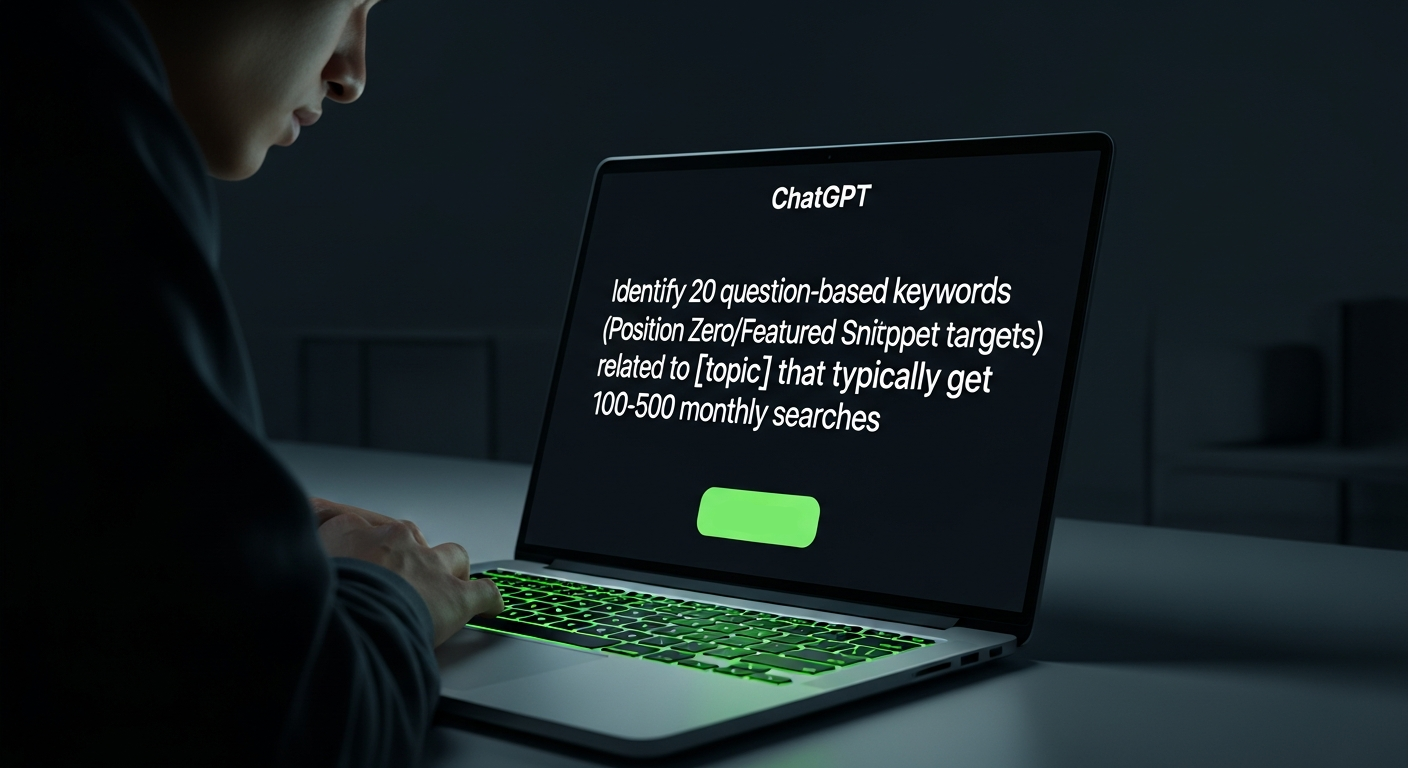
- 6.“Identify 20 question-based keywords (Position Zero/Featured Snippet targets) related to [topic] that typically get 100-500 monthly searches.”
- 7.“Generate LSI keywords and semantic terms for ‘[primary keyword]’ to naturally incorporate throughout content without over-optimization.”
- 8.“Map out a content pillar structure (topic clusters) for [niche] with 5-7 cluster topics underneath, including pillar page outline.”
- 9.“What long-tail keywords have high commercial or informational intent but low competition for ‘[broad keyword]’ in [industry]?”
- 10.“Create a comprehensive keyword research brief for [industry/niche] organized by search intent (informational, navigational, commercial, transactional).”
Category 2: Content creation and titles
- 1.“Write a compelling hook introduction for a guide on ‘[topic]’ that incorporates ‘[primary keyword]’ naturally within 100-120 words, using a surprising statistic or problem statement.”
- 2.“Generate 10 engaging headline variations for an article about ‘[topic]’ incorporating ‘[keyword]’ in exactly 60 characters or less.”
- 3.“Create a detailed outline for a comprehensive 2,500-word guide on ‘[topic]’ with H2 and H3 subheadings covering the entire topic from basics to advanced.”
- 4.“Generate 50 unique meta description variations for ‘[article topic]’ between 150-160 characters that include ‘[primary keyword]’ and entice clicks.”
- 5.“Write 5 different opening paragraphs for ‘[topic]’ using: statistic, question, story, surprising fact, problem-solution.”
- 6.“Expand this outline into a full 2,000+ word article using an expert persona: [outline]. Include transitions, real examples, and actionable takeaways.”
- 7.“How would you transform a 1,000-word article into a comprehensive 3,000-word pillar post on [topic]? Include new sections and deeper dives.”
- 8.“Generate a comprehensive FAQ section with 10-15 questions users commonly ask about ‘[topic]’ with concise answers.”
- 9.“Write 5 social media caption variations (Twitter, LinkedIn, Facebook, Instagram, Threads) for promoting an article about ‘[topic]’ with different CTAs.”
- 10.“Create a content brief template for freelance writers covering [topic]: target word count, primary/secondary keywords, required sections, CTA placement, examples.”
Category 3: On-page SEO optimization
- 1.“Generate 8-10 SEO-friendly URL structures for blog posts covering ‘[topic]’ that are concise and keyword-inclusive.”
- 2.“Create an H1-H3 header hierarchy for a ‘[topic]’ article that includes primary and long-tail keywords and supports Featured Snippet optimization.”
- 3.“Identify 10-15 semantically related keywords and LSI terms for ‘[primary keyword]’ to naturally weave into content.”
- 4.“Design a strategic CTA placement map for a ‘[topic]’ article showing where CTAs should appear with sample copy for each.”
- 5.“Create a content optimization checklist for SEO: keyword placement, readability targets, image alt text, internal linking strategy, meta data requirements.”
Category 4: Technical SEO
- 1.“Generate properly formatted XML sitemap structure for a website with [site description] following Google best practices.”
- 2.“Create robots.txt setup guidance optimizing crawl budget for [site size/niche].”
- 3.“Write .htaccess redirect rules (301 and 302) for these old to new URL mappings: [list].”
- 4.“Generate structured schema markup in JSON-LD format for [local business/product/article/FAQ] with these details: [details].”
- 5.“Create a canonical tag implementation guide covering self-referencing, duplicate content, pagination, and parameter handling.”
- 6.“Write hreflang tag code for international SEO targeting [countries/languages], including x-default fallback.”
- 7.“Design a technical SEO audit checklist: site speed, mobile responsiveness, crawlability, indexation, broken links, duplicate content, structured data, HTTPS, Core Web Vitals.”
Category 5: Competitive analysis and link building
- 1.“Identify topics my competitors [domains] covered extensively but we have not. Suggest 10 new content opportunities.”
- 2.“Identify 10 authoritative websites in [niche] that commonly link to ‘[topic]’ content and why they would find our content valuable.”
- 3.“Create an outreach email template for HARO responses in [niche] that establishes topical authority and provides genuine value.”
- 4.“Generate 20 anchor text variations for internal linking to ‘[page URL]’ that feel natural and include target keywords.”
- 5.“Map out a link-building strategy for ‘[topic]’: industry directories, media outlets, podcast guests, guest post targets, broken link opportunities.”
Category 6: Local and voice search
- 1.“Create a local SEO optimization checklist for [business type]: Google Business Profile, NAP consistency, local content strategy, review management, local structured data.”
- 2.“Design voice search optimization content for ‘[topic]’ using conversational language, question-based structures, and Featured Snippet-friendly formats.”
A note on prompt quality: WordStream’s best practices for using ChatGPT emphasize that prompt quality is everything. Vague inputs produce generic outputs. The prompts above include specific parameters (character counts, quantity targets, format requirements) precisely because that specificity is what separates useful output from generic filler.
For teams running higher volume, there’s also the purpose-built SEO GPT at chatgpt.com/g/g-GrshPDvS3-seo, a custom GPT configured specifically for SEO tasks with features like deep research, file uploads, and image generation. It’s worth testing for recurring SEO workflows where a specialized configuration saves repeated prompt engineering.
Building a ChatGPT SEO workflow: from strategy to execution
The 5-step ChatGPT SEO framework
A lot of ChatGPT SEO advice stops at “here are some prompts.” That’s not a workflow. It’s a collection of disconnected tasks. Here’s a framework that actually connects ChatGPT into a coherent SEO process.
Step 1: Research and validate
Start every project by using ChatGPT to generate breadth: keyword clusters, topic angles, competitor gap ideas, question clusters. The critical rule is that nothing from this step goes into a content plan until it’s been validated against real tools. Run your ChatGPT-generated keyword lists through Semrush, Ahrefs, or Google Keyword Planner. Check that the topics you’re targeting actually have search volume and match real searcher intent.
WordStream’s guidance is direct: treat ChatGPT as a brainstorming partner, not a data source. The validation step isn’t optional.
Step 2: Plan with precision
Once you have validated keywords and topics, go back to ChatGPT with specific briefs. This is where prompt quality determines output quality. Generic prompt: “Write an outline for an article about email marketing.” Specific prompt: “Create a detailed outline for a 2,500-word guide on ‘email marketing for SaaS companies’ targeting marketing managers, covering onboarding sequences, activation campaigns, and expansion revenue. Include H2 and H3 headers with word count targets for each section.”
Step 3: Generate multiple variations
Don’t take the first output. For title tags, ask for 10. For meta descriptions, ask for 5. For intros, ask for 3 different angles. The best option is rarely the first, and alternatives make the selection and editing process faster.
For longer content, generate section by section rather than asking for complete articles. Section-level generation gives you more control over quality and keeps fact-checking manageable.
Step 4: Inject voice and verify facts
This is the step most teams skip, and it’s why a lot of AI-assisted content underperforms. Raw ChatGPT output has a recognizable texture: confident, comprehensive, slightly lifeless. It lacks specific examples, honest admissions of uncertainty, and the small disagreements with conventional wisdom that make content feel authored rather than generated.
Add your own perspective. Replace generic examples with specific ones from your experience or research. Cut the filler phrases. Most importantly, verify every data point independently. ChatGPT’s hallucination rate is high enough that treating its statistics as fact is a real publishing risk.
The community discussions on OpenAI’s forum about SEO use cases are instructive: users who reported positive results with AI content consistently mentioned editorial processes that added unique value, rather than publishing ChatGPT output directly. DirectOM’s framework for ChatGPT visibility optimization makes the same point: content quality is the foundational requirement for both Google ranking and AI visibility.
Step 5: Optimize, publish, and iterate
After human editing and fact-checking, run your content through standard SEO optimization: internal linking, image optimization, schema implementation (which you can use ChatGPT to generate), page speed checks. Publish, then monitor.
Iteration matters more with AI-assisted content because the first version tends to be more generic than editorial-only work. Monitor performance at 30, 60, and 90 days. Pages ranking on page 2 often need a specific editorial update (more original research, a different angle on the intro, additional depth in a key section) rather than a full rewrite.
Common ChatGPT SEO mistakes to avoid
Publishing without editing. The most common mistake is also the most damaging. Analysis of ChatGPT limitations notes that the tool “produces repetitive, sometimes robotic writing.” That’s a consistent problem across the industry. The content that performs is content that’s been edited to have a perspective.
Relying on ChatGPT for current data. The April 2023 knowledge cutoff is fixed. ChatGPT can’t tell you what Google’s current guidelines say, what a competitor’s recent rankings look like, or what trending search terms emerged in the last year. Using it as a current-events source for SEO produces outdated guidance.
Treating keyword suggestions as validated. ChatGPT generates plausible keyword lists, not accurate ones. A keyword it suggests might have zero search volume, be miscategorized by intent, or be dominated by competitors you can’t beat. Every suggested keyword needs tool validation before it enters a content plan.
Ignoring the generic voice problem. WordStream’s point that ChatGPT “cannot generate content that embodies your unique voice” captures the output quality problem precisely. Generic content doesn’t build topical authority, doesn’t earn links, and doesn’t give readers a reason to return. The fix is editorial investment, not better prompts.
Over-automation without quality checks. The OpenAI community forum data on ChatGPT and Google rankings shows a clear pattern: users who published high volumes of lightly edited AI content saw sharp organic traffic drops after Google algorithm updates. Users who maintained editorial quality thresholds, even with AI assistance, reported stable or improved rankings.
Optimizing your website for ChatGPT visibility
This section is increasingly important and still underserved in most SEO guides. Using ChatGPT for SEO tasks is one thing. Getting your site to appear in ChatGPT’s search results is a separate optimization challenge.
Seven strategies to rank in ChatGPT search results
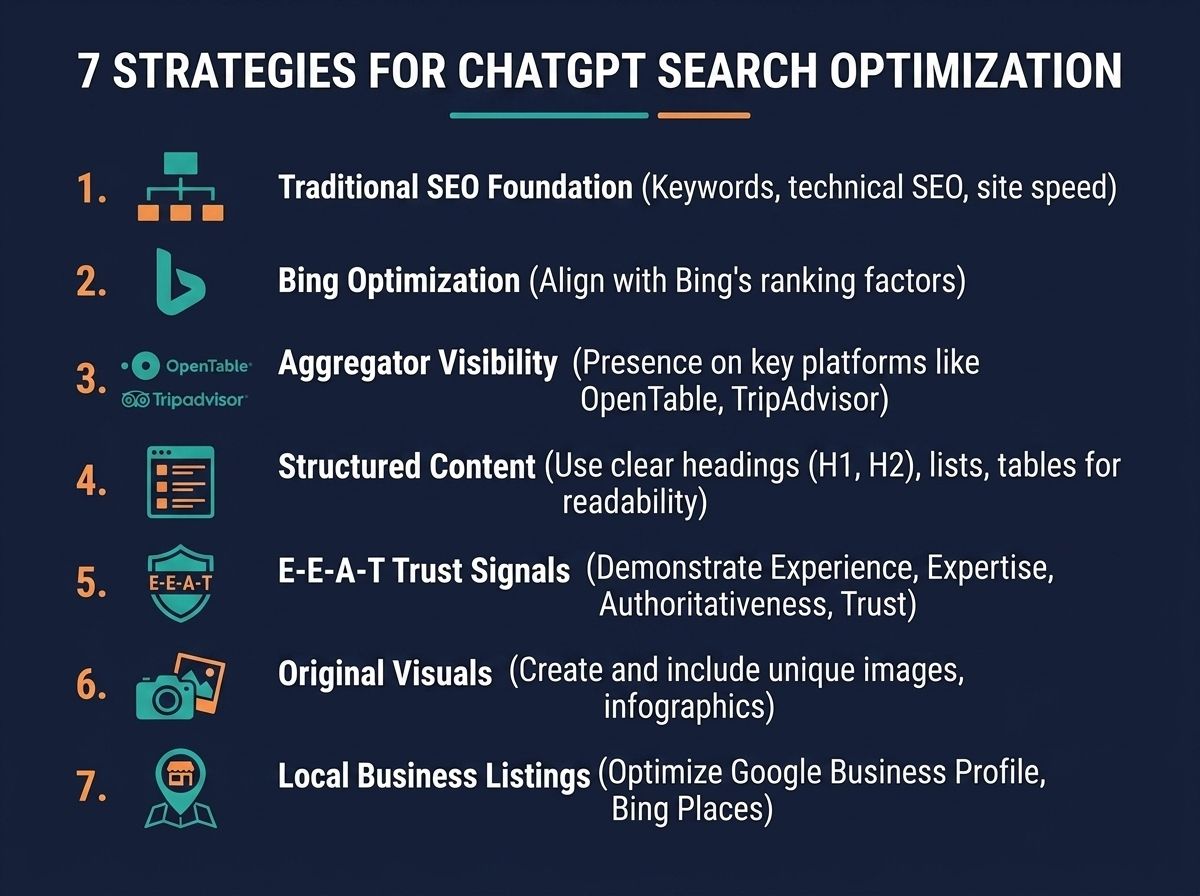
SEO.com’s research on ChatGPT optimization identifies seven specific strategies that increase the likelihood of appearing in ChatGPT’s search results. Given that ChatGPT Search results are 73% similar to Bing’s results, this isn’t an entirely separate discipline, but there are meaningful differences.
1. Traditional SEO foundation. The basics still matter: quality content, clean technical structure, proper on-page optimization. ChatGPT Search pulls from indexed web content, so sites that rank well on Bing and Google are the foundation of what ChatGPT surfaces.
2. Bing optimization. This is specific and actionable. Because Microsoft has a significant investment in OpenAI, ChatGPT Search is closely tied to Bing’s index. Submitting your sitemap to Bing Webmaster Tools, checking your Bing rankings, and ensuring your site is crawlable by Bingbot are more valuable for ChatGPT visibility than most SEOs have historically prioritized.
3. Aggregator visibility. ChatGPT frequently cites and pulls data from review aggregators and directories: OpenTable, TripAdvisor, PCMag, Capterra, and similar platforms. If your business or product is listed on these platforms with consistent, positive information, you’re more likely to appear in ChatGPT-generated recommendations for relevant queries.
4. Content structure. Headings, lists, and tables aren’t just good for readability. They’re how AI systems extract information. DirectOM’s framework for ChatGPT visibility optimization specifically recommends positioning concise answers near page tops, structuring content with clear logical organization, and using formatting that makes information scannable for both humans and AI parsing. A block of dense prose is harder for ChatGPT to extract a useful answer from than a well-structured H2 with a clear topic sentence.
5. Trust signals and E-E-A-T. Experience, Expertise, Authoritativeness, and Trustworthiness signals matter for ChatGPT citations just as they do for Google rankings. Author credentials visible on the page, citations to primary research, factual accuracy, and absence of misleading claims all factor into whether ChatGPT treats a source as citable.
6. Custom visuals. Original photography, proprietary graphics, and video content signal that a site produces genuine original work rather than republishing existing content. ChatGPT and Bing both weight original content signals. If all your images are stock photos, you’re missing a differentiation opportunity.
7. Local listings. For businesses with a local component, consistent presence across Bing Places, Yelp, Google Business Profile, and Apple Maps increases the probability of appearing in ChatGPT’s local and travel-related answers. SEO.com’s research identifies this as one of the seven core optimization strategies specifically because ChatGPT draws on these platforms for business-specific queries.
The ChatGPT-to-Google content overlap
The 73% Bing similarity finding from SEO.com has a practical implication: optimizing for ChatGPT visibility and Google ranking are more aligned than they are different. The fundamentals remain central to both: topical authority, high-quality original content, authoritative backlinks, technical health.
DirectOM’s research on ChatGPT visibility makes the topical authority point explicitly: sites that cover a subject comprehensively and consistently, rather than publishing isolated posts, earn stronger AI citation signals. This aligns with what Google’s helpful content guidance has been pushing for years. Breadth across a topic cluster, supported by strong internal linking and consistent E-E-A-T signals, builds the kind of topical authority that performs in both channels.
The content overlap also means that original research and proprietary data have increasing value. When ChatGPT searches for information on a topic, it’s looking for reliable, citable sources. Sites that publish original studies, surveys, or data analyses become reference points that other pages link to and AI systems cite. That compounds over time in ways that republished or generic content doesn’t.
The OpenAI community discussion on ChatGPT’s impact on SEO noted that legitimate backlinks and high presentation quality were consistently correlated with positive AI visibility outcomes. That’s not a different strategy from good SEO. It’s the same strategy applied to a new distribution channel.
Early adoption matters here. DirectOM’s analysis specifically notes that “early adopters of AI-compatible SEO gain competitive advantage.” The sites building structured, authoritative, AI-readable content now are establishing citation patterns before their categories get crowded.
Conclusion
ChatGPT for SEO works. Not as a replacement for tools, not as a shortcut past editorial quality, and not as a source of verified data. It works as a workflow accelerator that compresses the time-consuming parts of SEO significantly.
The practical summary: use ChatGPT for the ideation, structuring, and drafting stages of SEO work. Validate everything with real tools before it enters your content plan. Edit everything before it goes live. Never skip the voice injection step.
The 39 prompts in this guide are templates, not scripts. The value compounds when you customize them: add your specific niche, your target reader’s experience level, the specific angle you’re taking on a topic. A prompt that takes 90 seconds to customize produces output that’s genuinely usable rather than generically correct.
The future direction that’s easy to underweight: ChatGPT visibility isn’t a separate SEO discipline you’ll get to later. The 300 million weekly users that aren’t all going back to Google for every query. Some of them are finding content, products, and services through ChatGPT Search and never clicking through to a traditional SERP at all. Current data shows ChatGPT at 2% of Google’s traffic volume, but that number is moving in one direction. See how AI Overviews are already reshaping traffic patterns for sites that are and aren't being cited.
The seven ChatGPT optimization strategies (traditional SEO foundation, Bing optimization, aggregator visibility, content structure, trust signals, custom visuals, local listings) aren’t complex. Most of them are things you should be doing for Google already, redirected toward a slightly different audience. The difference is intentionality: actively verifying your Bing visibility, systematically building your aggregator presence, structuring your content for AI extraction as explicitly as you structure it for human readability.
Using ChatGPT for SEO and optimizing your site for ChatGPT visibility are two sides of the same strategy. The sites that do both, using the tool well while positioning themselves as sources the tool cites, are the ones that will benefit most from the shift in how people search.
The gap between ChatGPT as a productivity tool and ChatGPT as a distribution channel is closing. The time to build for both is now.
Frequently Asked Questions
How do you use ChatGPT for SEO?
ChatGPT accelerates SEO workflows in several ways: keyword research and clustering by asking it to generate topically related terms for a seed keyword, content outline creation for target queries, meta title and description drafting, FAQ generation, internal linking suggestions, and first-draft content production that human editors then refine. The highest-ROI use cases are tasks that involve pattern recognition and generation rather than real-time data analysis, where ChatGPT's training cutoff is a limitation.
Is ChatGPT good for SEO keyword research?
ChatGPT is useful for exploratory keyword research — generating long-tail keyword ideas, identifying question-based queries, and organizing keywords into topic clusters. However, it does not provide real search volume, competition data, or SERP analysis. For accurate keyword metrics you still need dedicated tools like Ahrefs, Semrush, or DataForSEO. Use ChatGPT to ideate and structure keyword lists, then validate volume and difficulty data with a dedicated keyword research tool.
Can ChatGPT replace traditional SEO tools?
No. ChatGPT cannot replace traditional SEO tools because it lacks real-time data, does not provide backlink analysis, cannot audit technical site issues, and has no access to live search volume or ranking data. As WordStream research notes, ChatGPT alone cannot generate content that adheres to SEO guidelines or reflect current SERP dynamics. It works best as a productivity layer on top of traditional SEO tools, not as a replacement.
What are the best ChatGPT prompts for SEO?
High-performing ChatGPT prompts for SEO include: 'Generate 20 long-tail keyword variations for [primary keyword]', 'Create an SEO content outline for [target keyword] targeting [search intent]', 'Write 5 meta title options for a page about [topic] under 60 characters', 'List 10 FAQ questions a user searching for [keyword] would ask', and 'Suggest internal linking opportunities for an article about [topic] on a website covering [niche]'. Specificity in prompts — naming the keyword, audience, and intent — consistently produces more usable output.
How do you optimize your website for ChatGPT search?
To optimize for ChatGPT search (ChatGPT Browse and ChatGPT Search), allow GPTBot access in your robots.txt file, structure content with clear H2 headings that match question formats, include FAQ sections with direct answers, cite authoritative external sources inline, and build your brand's presence in publications that OpenAI's training data includes. Pages that answer specific questions concisely and cite named sources are more likely to be retrieved and surfaced by ChatGPT.
What are the limitations of using ChatGPT for SEO?
The main limitations of using ChatGPT for SEO are: no real-time data (training cutoff means it cannot report current rankings or trends), no backlink or domain authority data, inability to crawl or audit live sites, risk of factual hallucinations on specific statistics, and content that can sound generic without strong human editing. ChatGPT is most reliable for structural and ideation tasks and least reliable for data-dependent tasks like competitive analysis or reporting on current algorithm updates.