Google still processes over 14 billion searches every day. Yet 35% of Gen Z now opens ChatGPT before they open Google, according to Gartner. That gap is widening fast. Where searches happen and where discovery actually occurs are no longer the same place. If you’re a marketer who’s spent years perfecting your organic rankings, the question isn’t whether AI-powered search matters. It’s whether your content shows up when it does.
A May 2025 Forbes report by John Werner documented the business-level shift underway: companies that rank well in traditional search are now actively building GEO competency because AI-generated answers are where their customers start. Werner reported that this isn’t theoretical disruption. It’s a reallocation of marketing resources already happening at major brands.
The tension at the center of modern digital marketing is the geo vs seo debate: two different systems, two different logics, two different definitions of “winning.” SEO has been the dominant framework for two decades. Generative engine optimization (GEO) is newer, less standardized, and converting at rates that can’t be ignored despite far lower search volume than traditional search.
This guide explains what separates generative engine optimization from traditional SEO, why the difference matters for your traffic and brand, and how to optimize for both without doubling your workload. These two approaches aren’t competitors. They’re layers, and the most visible brands right now are building both.
What is GEO vs SEO and why the difference matters
Let’s start with definitions, because “GEO” gets used loosely.
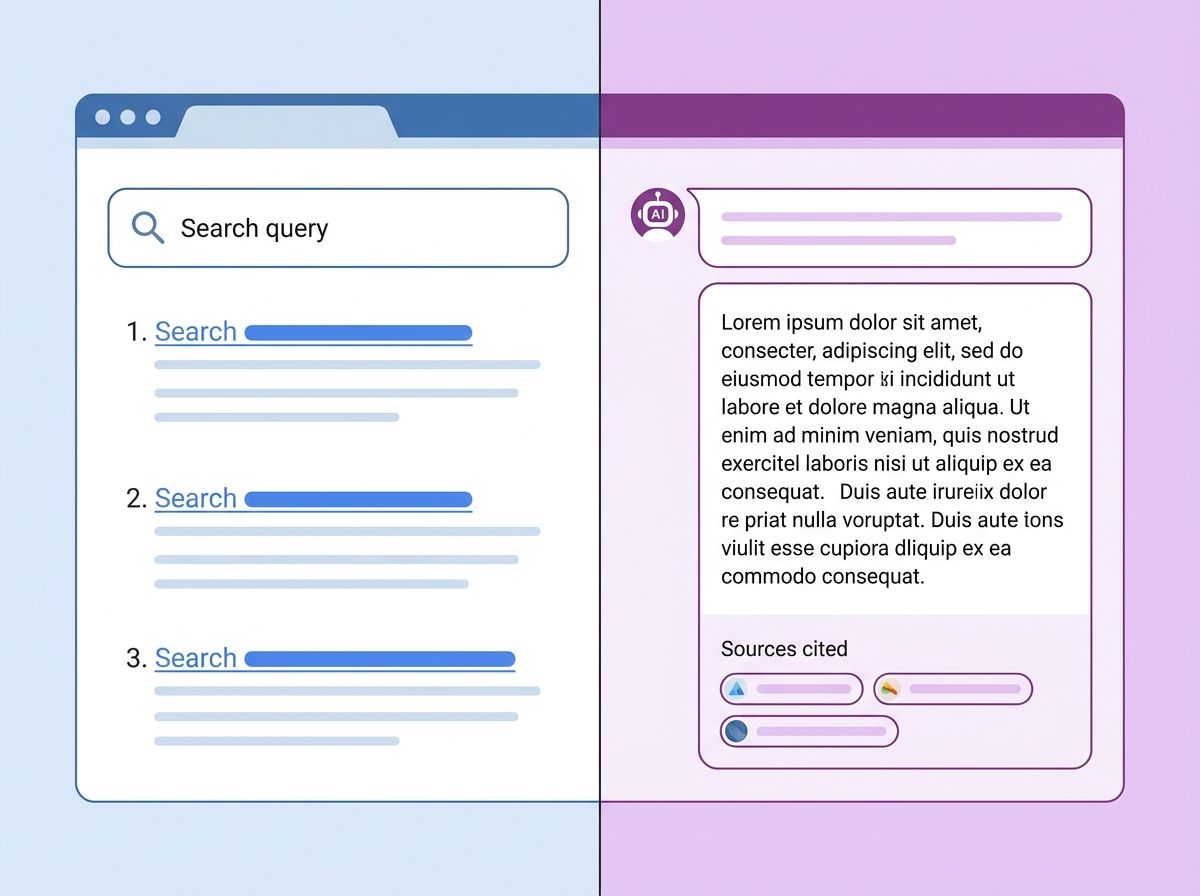
SEO, search engine optimization, is the practice of making content visible to traditional search engines like Google and Bing. These engines use web crawlers to index pages, then apply hundreds of ranking signals (backlinks, keyword relevance, page speed, E-E-A-T signals, structured data) to produce a ranked list of links. Users get 10 blue links per page, or thereabouts, and choose where to click.
GEO, generative engine optimization, is the practice of making content discoverable, summarizable, and accurately represented by AI-powered platforms: ChatGPT, Gemini, Perplexity, and Google AI Overviews. These systems don’t return link lists. They generate a single synthesized answer and surface 2-7 cited sources per response, if they cite sources at all. As a LinkedIn expert in the optimization space put it: “SEO optimizes for ranking. GEO optimizes for selection.”
That single sentence explains the seo vs geo difference better than most explainers. SEO is about achieving a position. GEO is about being included at all.
As Forbes contributor John Werner noted in May 2025: “If your business isn’t appearing in AI-generated answers, potential customers may never discover you, even if you rank well in traditional search results.” That framing captures the urgency. Strong organic rankings no longer guarantee visibility to users who start their research in ChatGPT or Perplexity.
The underlying technology explains why the outputs differ so sharply. SEO search engines rely on PageRank-style algorithms that evaluate page authority based on link graphs and keyword signals. GEO platforms rely on large language models built on transformer architecture, often combined with retrieval-augmented generation that pulls live web content into responses. These systems don’t “rank” your page. They convert your content into numerical embeddings, retrieve relevant chunks, and synthesize an answer. Your page’s rank on Google has almost no bearing on whether an LLM selects it.
How disconnected are the two systems? Research from 2024 found that the overlap between top Google links and AI-cited sources dropped from 70% to below 20%. If you’re assuming your SEO rankings translate into AI visibility, that assumption is wrong. As dotCMS notes directly: “Content excelling in SEO may still underperform with AI engines if not optimized for machine comprehension and accurate summarization.”
The query format also differs substantially. A16z research found the average SEO query is roughly 4 words. The average GEO query runs 23 words: conversational, contextual, and specific. “Best CRM for small e-commerce teams under $50/month” is a GEO query. “Best CRM” is an SEO query. These attract different content types, reward different writing styles, and require different content structures.
Content lifespan also separates the two systems. A well-optimized SEO page can rank for years. GEO citation is far less stable. Between 40% and 60% of AI-cited sources change month-to-month, according to Search Engine Land data. Freshness is a live ranking signal in GEO in a way it simply isn’t for most SEO content.
The AI-driven search shift and why it’s happening now
The numbers behind this shift moved fast in early 2025, and they’re worth anchoring to real data rather than vague claims about “AI disrupting search.”
Semrush found that Google AI Overviews appeared in 13.14% of all queries by March 2025, up from 6.49% in January. That’s a doubling in three months. Separately, Bain & Company’s research with Dynata found that 80% of consumers now rely on AI-written results for at least 40% of their searches, a dynamic that reports is reducing organic web traffic by 15% to 25%. Ahrefs found that for content that does rank at the top of Google, AI Overviews cut click-through rates by 58%.
This is the ai seo vs geo marketing problem in concrete terms: you can rank first and still lose half your clicks.
The platforms involved have genuine scale. AI Overviews had 1.5 billion monthly users in Q1 2025. ChatGPT has 800 million weekly users. Gemini has 750 million monthly users. These aren’t niche products. They’re where a meaningful share of your target audience is now spending research time.
A16z documented a striking real-world example. Vercel, the developer platform, found that ChatGPT refers 10% of its new signups. A16z also noted that ChatGPT drives referral traffic to tens of thousands of distinct domains. The form builder Tally went further: ChatGPT became its number one referral source entirely. That kind of GEO success doesn’t happen by accident. It happens when content is structured in a way that LLMs can extract and cite.
AI search traffic converts at 14.2% vs. Google organic’s 2.8%, roughly 5x higher. The volume is smaller (ChatGPT processes about 37 million searches per day vs. Google’s 14 billion, a 373x gap), but each citation carries significantly more value per visitor. This is why GEO matters even if it doesn’t yet match SEO volume.
Gartner’s projections suggest this gap will narrow. They predict a 25% drop in traditional search engine volume by 2026, and a 50% drop in organic traffic by 2028 as AI-native behaviors become default. The Apple signal reinforces this direction: the company is integrating Perplexity and Claude directly into Safari search, a structural threat to the $80 billion SEO industry that a16z has flagged explicitly.
The generational angle compounds the urgency. Gen Z adoption of AI-first search runs at 35%, compared to 19% for millennials and 7% for Gen X. Your youngest customers are already in GEO territory. Your oldest customers mostly aren’t, yet. That’s the window for building competency before the shift fully matures.
One honest counterweight: Google still processes 373x more daily searches than ChatGPT. The case for geo vs seo marketing isn’t that GEO replaces SEO. It’s that the two operate on different systems with increasingly different signals, and visibility in one doesn’t guarantee visibility in the other.
Ranking signals and citation mechanics: what each engine actually rewards
Understanding the seo vs geo difference at the signal level changes how you think about content creation. The overlap is real but partial.
What SEO rewards
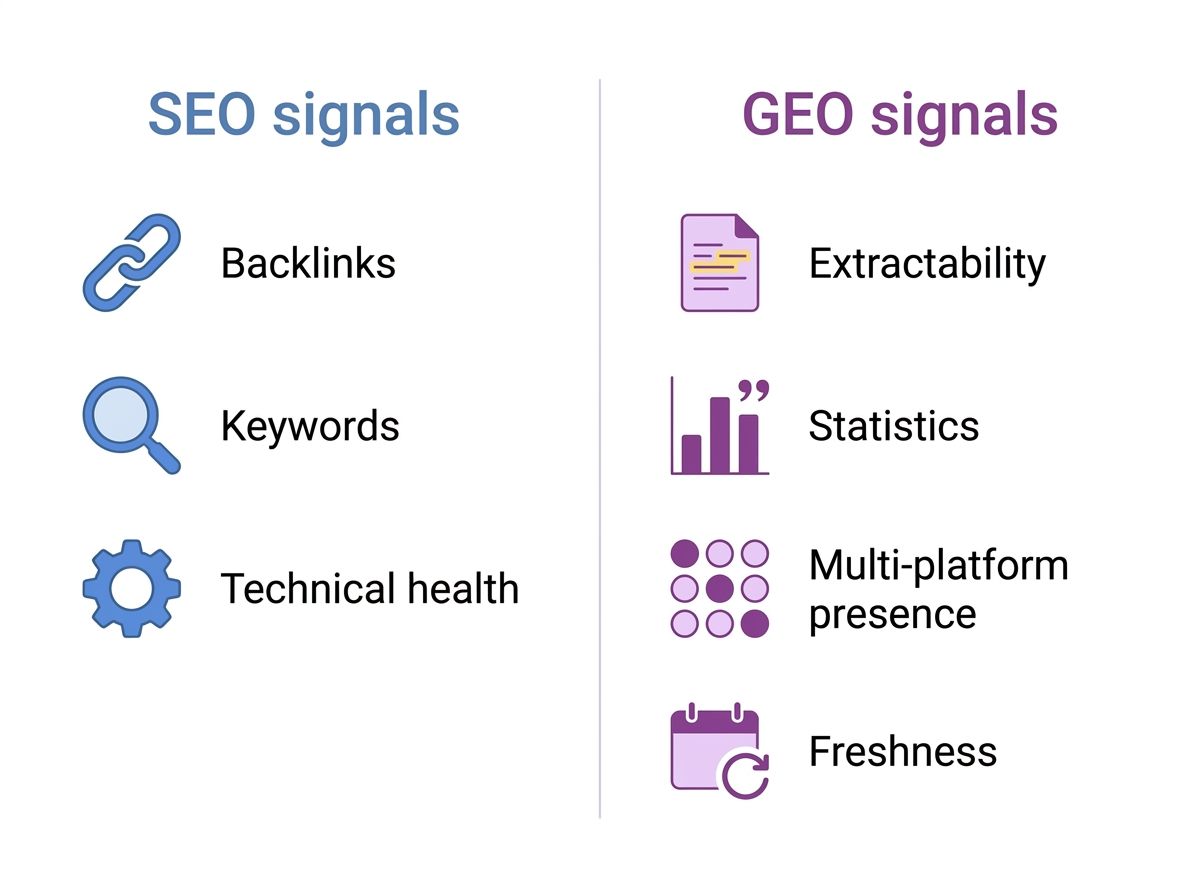
Traditional search engine optimization runs on backlinks and domain authority, on-page keyword optimization across titles, headings, meta descriptions and body content, technical signals like Core Web Vitals and mobile-friendliness, E-E-A-T (Experience, Expertise, Authoritativeness, Trustworthiness), and structured data like schema markup. Internal link architecture and topical cluster depth also matter significantly.
These signals are well-documented, stable, and measurable. The SEO industry spent two decades building tooling, benchmarks, and best practices around them. Ahrefs, Semrush, Moz: the standard platforms track this infrastructure reliably.
What GEO rewards
GEO citation signals are different in character. The research is clearer than most practitioners realize.
A GEO academic paper published on arxiv found that Statistics Addition improves GEO visibility by 41% and Quotation Addition improves it by 28%. These aren’t marginal gains. They’re the highest-impact single interventions identified in the study. Name your statistics’ sources explicitly in the text. Add direct quotes from credible experts. Both tactics make content more citable by AI systems.
Content extractability matters enormously. AI systems retrieve chunks, not pages. Each section of your content needs to be self-contained enough to make sense in isolation, because that’s how LLMs actually consume it. A paragraph that relies on context from three sections earlier won’t get cited. A paragraph that fully answers a specific question will.
Entity clarity is a foundational GEO signal that practitioners underestimate. LLMs build understanding of a brand from the aggregate of web mentions: your Wikidata entry, Crunchbase profile, LinkedIn page, and third-party review summaries all feed the model’s concept of what your brand does and who it serves. Inconsistent descriptions across these sources create ambiguity that reduces citation accuracy and frequency. Consistent entity signals across owned and third-party platforms make your brand more legible to LLMs.
Multi-platform presence carries disproportionate weight in GEO. Semrush data shows earned media, including forum discussions, third-party reviews, LinkedIn posts, Reddit threads, and YouTube videos, gets cited far more often than brand-owned content. Reddit, LinkedIn, and YouTube rank among the top cited domains by major LLMs. Building a presence on Wikidata, Crunchbase, and G2/Capterra isn’t just brand hygiene. It’s GEO infrastructure.
Freshness is a live signal. DotCMS notes that “models pull from what’s available and recent,” and the citation volatility data backs this up. Sources cited in AI responses change 40-60% month-to-month. Stale content loses citation share fast.
Where the two systems diverge most sharply
SEO rewards one well-optimized page on your domain. GEO rewards breadth across the entire web. Backlinks signal authority to Google; third-party mentions, reviews, and forum discussions signal authority to LLMs. Keyword repetition can help SEO; keyword stuffing consistently underperforms in GEO contexts.
There’s also no “Position #1” in GEO. Visibility is a frequency metric: how often your brand gets mentioned across a consistent set of queries. There’s no leaderboard to climb, only inclusion rates to monitor.
Platform-specific behavior matters too. ChatGPT synthesizes without always showing sources and rewards clear, factual prose. Perplexity emphasizes citations explicitly, making it the most transparent about sourcing. Google AI Overviews prefer already-indexed Google content and behave similarly to featured snippet logic. Gemini follows Google patterns but produces less structured results. Semrush notes that content performing in Google AI Overviews is likely indexed by Google and formatted for direct-answer extraction.
The 26% stat from marketingltb.com is striking: 26% of brands have zero mentions in AI Overviews despite ranking well in organic search. These brands are invisible to a growing share of their potential customers, not because their content is low-quality, but because it isn’t structured for AI extraction.
KPIs for GEO vs SEO: measuring what actually matters
This is where the two disciplines diverge most practically. The SEO measurement stack is mature. The GEO measurement stack is being built right now.
SEO KPIs: familiar and trackable
Standard SEO measurement covers keyword rankings (positions 1-10 in SERPs), organic traffic volume in sessions and users, click-through rate from search results, bounce rate and engagement metrics, domain authority and backlink count, conversion rate from organic, and Core Web Vitals scores. All of this runs through Google Search Console, GA4, and third-party tools like Ahrefs and Semrush.
The KPIs are stable, benchmarks exist, and reporting cadences are established.
GEO KPIs: emerging and genuinely harder to track
The kpis for geo vs seo differ more in infrastructure than in concept. You still want to know if your content is reaching the right people at the right moment, you just measure that differently.
AI citation frequency is the primary GEO KPI: how often AI platforms mention your brand across a consistent set of test prompts. Share of voice tracks your mention rate against competitors in AI responses. Sentiment analysis checks whether AI mentions are positive, neutral, or negative, which matters because LLMs can describe your brand inaccurately. Context tracking identifies which specific prompts reliably trigger your brand mentions.
Citation volatility is a metric unique to GEO: how much your citation rate changes month-to-month. At 40-60% turnover among cited sources, the answer is “a lot.” AI-driven referral traffic can be tracked via UTM parameters when AI platforms link out. Zero-click displacement rate, meaning how often AI summarizes a query you used to own with your content, is harder to measure but increasingly important.
What GEO measurement looks like in practice: a SaaS company running weekly test prompts like “best project management tool for remote teams” might find they appear in Perplexity 3 times out of 10 and zero times in ChatGPT. That gives them a baseline citation rate of 30% on Perplexity and 0% on ChatGPT, and a clear GEO gap to close. That kind of prompt-by-prompt tracking is the most actionable starting point most teams can implement today, before purpose-built tooling takes over.
New measurement vocabulary has emerged: “AI visibility score” for brand appearance frequency, “overview visibility” for presence in Google AI Overviews, and “position-adjusted word count” from the academic GEO research.
The honest challenge: traditional analytics can’t track AI visibility. Specialized tools have emerged, including Profound, Goodie, Daydream, and BrandMentions, that monitor brand appearance, sentiment, and competitive share of voice in AI responses. A16z flagged that legacy tools are catching up too: Ahrefs and Semrush have both developed AI-specific tracking tools.
26% of brands have zero mentions in AI Overviews despite strong organic rankings. These brands don’t know they’re invisible in AI search because their standard dashboards don’t surface it.
GEO measurement is genuinely immature. You’re building reporting infrastructure now that will standardize over two to three years, similar to how GA4 replaced Universal Analytics, or how domain authority replaced raw PageRank as a proxy metric. The practical move now: define a fixed set of 10-20 test prompts that reflect your customers’ actual research questions. Run them manually or with tools weekly. Track inclusion rate. Note which competitors appear when you don’t. That’s your baseline.
How to optimize for GEO and SEO simultaneously: practical tactics
The foundation is the same. High-quality, well-structured, authoritative content is rewarded by both systems. E-E-A-T applies to both: identifiable expert authors, demonstrated domain knowledge, and first-hand experience all matter. Clear, direct answers to specific questions feed both featured snippets and AI citations. Schema markup serves SEO indexing and GEO credibility verification at the same time.
You don’t need two separate content workflows. You need one workflow that layers GEO signals on top of good SEO practice.
The GEO layer: what to add
Write for extractability first. Structure every H2 section so that it fully answers its question within that section. Don’t assume the reader has read the previous section, and neither will the AI. Self-contained paragraphs get cited. Dependent prose doesn’t.
Add statistics and quote every source explicitly in-text. The arxiv GEO research is clear on this: Statistics Addition improves GEO visibility by 41%. “According to Gartner…” and “Semrush found…” and “A16z data shows…” are not just citation hygiene. They’re GEO signals.
Build multi-platform presence actively. Contribute substantive answers to Reddit threads in your niche. Publish LinkedIn posts that take specific positions. Maintain your Wikidata and Crunchbase entries. Earn reviews on G2 or Capterra if you’re a software company. The content LLMs cite most isn’t owned media. It’s earned media. Create the conditions for it.
Update content on a quarterly cycle at minimum. Add dated data points when you publish, “as of March 2025” rather than “recently.” AI models favor what’s available and recent. Stale pages lose citation share fast.
Use Q&A formatting in your structure. H2 sections phrased as questions, such as “What is the difference between GEO and SEO?”, align with how AI systems are prompted. The match between query format and content format matters.
Create original data worth citing. Proprietary research, distinctive frameworks, and specific benchmarks earn external mentions from other publishers. Those external mentions become the third-party signals LLMs treat as credibility. This is the GEO version of “citation bait”: content designed to earn mentions, not just links.
None of these GEO tactics require abandoning the SEO foundation. They’re additive, not substitutional.
The SEO layer: don’t abandon it
Continue technical SEO: crawlability, Core Web Vitals, mobile optimization. Maintain internal linking and topical cluster architecture. Pursue quality backlinks. Google processes 373x more daily searches than ChatGPT, so organic traffic remains significant and will remain significant for years.
The workflow integration is simpler than it sounds. Draft content for GEO first: conversational, structured, extractable, with explicitly sourced statistics and clear direct answers. Then layer in primary and secondary keywords for SEO. Add an FAQ section at the end. It serves both featured snippet extraction and AI citation.
Monitor AI mentions alongside rank tracking. Set a weekly or bi-weekly cadence for your test prompt set. Know what your competitors are getting cited for that you’re not.
SEO practitioners who follow this space in communities like r/SEO note that the real strategic question isn’t which system to optimize for. It’s sequencing a single content workflow to feed both systems without doubling production effort. The practical finding from those conversations: teams that draft for GEO extractability first, then layer in keyword targeting, tend to serve both channels better than teams that reverse the order.
One thing that doesn’t help either system: publishing content with vague attributions (“studies show,” “experts agree”), keyword stuffing, or thin coverage. Both systems penalize low-quality content differently. Google buries it in rankings; LLMs simply never cite it.
Conclusion
The geo vs seo question has a clear answer: it’s not either/or. It’s sequence and stack.
AI search converts at roughly 5x the rate of traditional organic clicks, 14.2% vs. 2.8%. Google still processes 373x more daily searches than ChatGPT. The case for building GEO competency isn’t that AI search will overtake traditional search next quarter. It’s that the gap is closing, the conversion quality advantage is real, and 26% of brands are currently invisible in AI Overviews despite ranking well in organic. Being in that 26% is an avoidable problem.
The practical starting point is immediate. Run the 10-15 queries your customers actually type into search, “best [your category] for [their use case],” into ChatGPT, Perplexity, and Google AI Overviews today. Note who appears and who doesn’t. If your brand isn’t cited, that’s your GEO gap. Fix it the same way you’d fix an SEO gap: structured content, explicit sourcing, earned media, freshness.
The brands building GEO competency now will have a compounding advantage by 2027, the same way early SEO adopters owned SERPs for years after the field matured. Generative engine optimization is where SEO was in 2004: real, important, and still early enough that doing it well creates a durable edge. The tools, benchmarks, and standards will mature. Your content should be ready before they do.
Sources: InformaTechTarget, Forbes/John Werner (May 2025), a16z, Semrush, dotCMS, LinkedIn/optimization, Reddit/r/SEO, Bain & Company/Dynata, Ahrefs, Gartner, Search Engine Land, arxiv (GEO academic research)
Frequently Asked Questions
What is the difference between GEO and SEO?
SEO (Search Engine Optimization) focuses on ranking web pages in traditional search engines like Google and Bing through keyword optimization, backlinks, and technical site health. GEO (Generative Engine Optimization) focuses on getting your content cited in AI-generated answers from platforms like ChatGPT, Perplexity, and Google AI Overviews. SEO drives traffic to your pages; GEO earns citations in AI responses, often without a click to your site.
Should I focus on GEO or SEO in 2026?
You should invest in both, not one or the other. Traditional search still handles the majority of informational and commercial queries, making SEO essential for organic traffic. GEO is growing rapidly as AI platforms capture more zero-click searches. The strategies complement each other: strong topical authority, structured content, and authoritative citations benefit both search engine rankings and AI citation rates simultaneously.
What is generative engine optimization (GEO)?
Generative engine optimization (GEO) is the practice of structuring and positioning content so that AI-powered generative engines select it as a trusted source in their responses. This includes writing answer-first content that directly addresses user queries, earning citations from authoritative sources AI models rely on, adding schema markup, and ensuring AI crawlers can access your pages. GEO was formally defined in a 2024 Princeton study that identified the key content signals that increase AI citation rates.
Can GEO and SEO strategies work together?
Yes, and they largely overlap. Content optimized for GEO — structured, expert, authoritative, and directly answering user questions — also tends to perform well in traditional search. Both disciplines value E-E-A-T (Experience, Expertise, Authoritativeness, Trustworthiness), topical depth, and quality backlinks. The main divergence is that SEO prioritizes on-page keyword signals and crawl efficiency, while GEO prioritizes content extractability and third-party citation signals.
How do KPIs differ for GEO vs SEO?
SEO KPIs include organic traffic, keyword rankings, click-through rate, domain authority, and conversion rate from search visitors. GEO KPIs include AI citation rate, share of AI voice, brand mention frequency across AI platforms, AI-referred traffic in GA4, and the quality of contexts in which your brand is cited. As AI search matures, GEO metrics are becoming a standard addition to digital marketing dashboards alongside traditional SEO reporting.
How does GEO affect organic search traffic?
GEO can reduce traditional organic click-through rates because AI-generated answers resolve queries without users clicking to source pages. Research from InformaTech Target indicates zero-click AI responses are reducing organic web traffic to some sites by 15% to 25% year-over-year. However, brands that achieve strong GEO visibility often see an increase in direct traffic and branded search volume, as AI citations build awareness and authority that converts at higher rates than generic organic visits.
Can GEO replace SEO?
No. GEO and SEO serve different user behaviors. Traditional search still handles the majority of queries and drives significant commercial intent traffic. GEO is increasingly important for informational and research-stage queries. The most effective strategy optimizes for both simultaneously, as the technical and content signals overlap significantly.
Do I need GEO if I already do SEO?
Yes. SEO and GEO are complementary but address different channels. A strong SEO presence helps GEO — domain authority influences AI citation probability — but SEO alone does not guarantee AI visibility. Sites need to additionally implement FAQPage schema, allow AI crawlers, publish original data, and structure content for direct-answer extraction to perform well in AI search results.