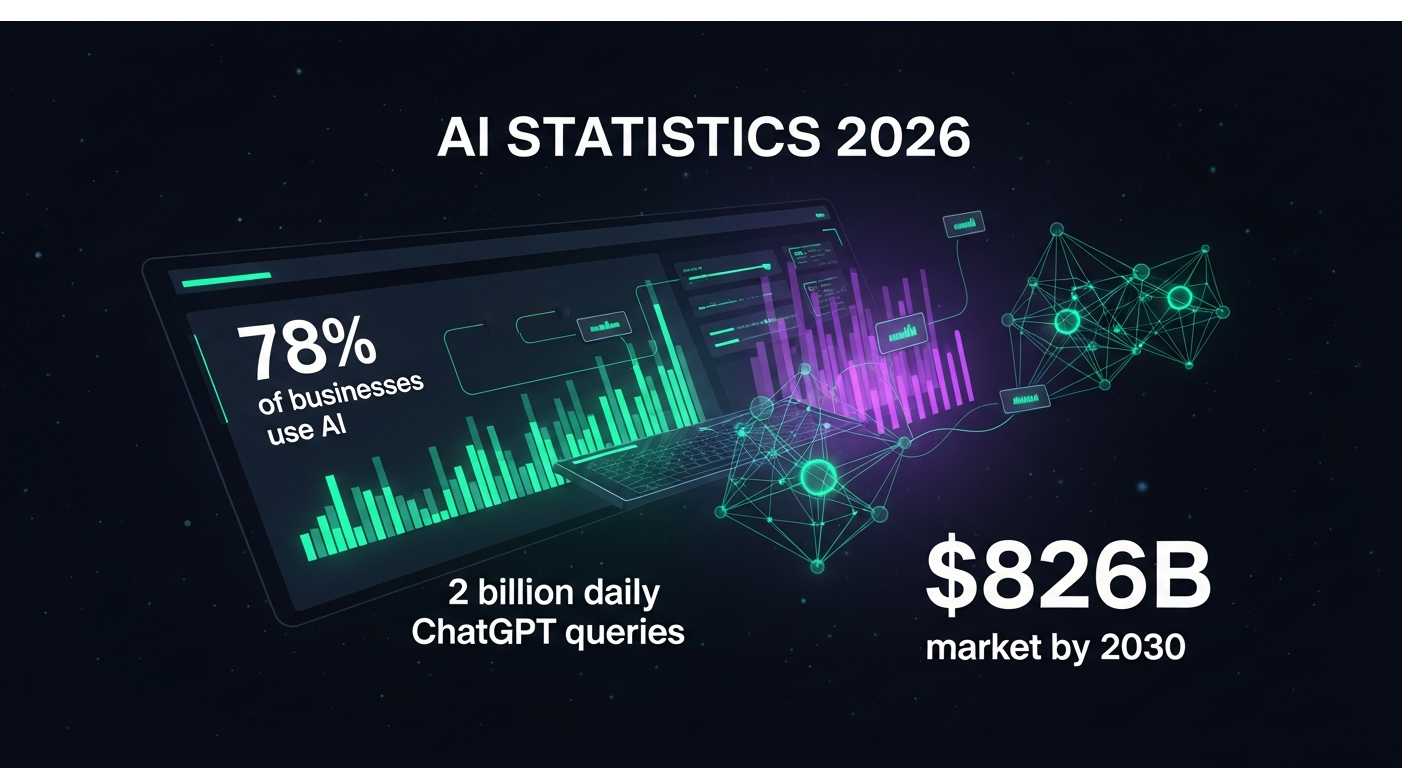
The numbers are staggering, and they keep growing. Somewhere between the breathless headlines about AI replacing everything and the skeptics insisting it’s all hype, the actual data tells a more complicated story.
In 2026, artificial intelligence is genuinely embedded across business, education, healthcare, and everyday consumer life. But adoption is uneven, ROI is real for some and elusive for others, and the workforce impact is playing out in ways that don’t fit neat narratives.
This article pulls together the most significant AI statistics from leading research organizations - McKinsey, Stanford’s Human-Centered AI Institute, Statista, Gartner, PwC, and others - to give you an honest picture of where AI actually stands. Whether you’re making investment decisions, planning workforce strategy, or just trying to understand what’s really happening, these numbers matter.
One framing note before we begin: many AI statistics are projections or surveys, and they carry real uncertainty. Where a number comes from a projection, we’ve said so. Where it’s survey-based, we’ve named the survey. The goal is to give you data you can actually use, not a highlight reel of the most impressive-sounding figures.
We’ve organized the data into ten sections, moving from market-level macro trends down through enterprise adoption, individual usage, workforce dynamics, and sector-specific breakdowns. We close with the AI agents story - arguably the most important development in AI right now - and the evolving picture of consumer trust. If you’re short on time, the “at a glance” section and the bottom line give you the core of it.
Table of contents
- 1.Key AI statistics at a glance
- 2.AI market size and growth statistics
- 3.Enterprise AI adoption statistics
- 4.Generative AI usage statistics
- 5.AI productivity and ROI statistics
- 6.AI and the workforce: what the data shows
- 7.AI by industry: sector-specific statistics
- 8.AI agents: the numbers on the next frontier
- 9.Consumer trust and AI perception statistics
- 10.The bottom line
AI statistics 2026 - data center with server infrastructure and digital processing
Key AI statistics at a glance
Before diving into the details, here’s a snapshot of where AI stands in 2026:
- 1.The global generative AI market is projected to reach $356.10 billion by 2030, growing at a 46.47% compound annual growth rate, according to Statista.
- 2.88% of organizations now use AI in at least one business function, per McKinsey’s 2025 State of AI survey.
- 3.115 to 180 million people use ChatGPT daily - a figure that would have been hard to imagine three years ago.
- 4.92% of Fortune 500 companies have adopted generative AI in some capacity.
- 5.Organizations that have deployed AI seriously report an average 24.69% productivity increase.
- 6.On workforce impact, the World Economic Forum estimates 85 million jobs face displacement - but projects 97 million new roles will emerge, a net gain of 12 million positions.
- 7.Only 7% of organizations have fully scaled AI across their enterprise. The majority are still in pilot phases.
- 8.Microsoft research puts the return on AI investment at $3.50 for every $1 spent.
- 9.1,000+ AI bills were introduced in the U.S. in 2025 alone, signaling serious regulatory acceleration.
- 10.The EU AI Act’s enforcement oversight begins in August 2026, with maximum penalties reaching €35 million or 7% of worldwide revenue.
That last point about full-scale adoption deserves emphasis. Despite massive investment and constant headlines, only 7% of companies have actually integrated AI at scale. That gap between intent and execution is one of the defining stories of AI in 2026 - and it has real implications for anyone trying to interpret the market numbers.
It’s also worth noting that AI awareness and AI usage are different things. Research found that 77% of Americans actually use AI in some form, but only 33% think they do. Most people don’t recognize the AI built into their daily tools - recommendation algorithms, spam filters, voice assistants, and navigation apps are all AI-powered but have been normalized to the point of invisibility.
AI market size and growth statistics
The market numbers are where AI’s trajectory becomes undeniable. This isn’t a technology finding its niche slowly - it’s one of the fastest-growing markets in modern economic history.
- 1.The generative AI market is on track for $356.10 billion by 2030, expanding at a 46.47% CAGR (Statista).
- 2.Bloomberg’s projection is higher: $1.3 trillion by 2032.
- 3.The U.S. generative AI sector alone is projected to reach $302.31 billion by 2034, up from $7.41 billion in 2024, at a 44.90% annual growth rate (GlobeNewswire).
- 4.AI is projected to contribute $15.7 trillion to the global economy by 2030 (PwC).
- 5.The overall AI market grew 33% in 2024, with growth rates for specific segments exceeding 120% (Exploding Topics).
- 6.92% of businesses plan to increase AI investments between 2025 and 2027.
- 7.High-performing AI companies allocate more than 20% of their digital budgets to AI, compared to lower performers (McKinsey).
- 8.The AI agents market alone could generate $450 billion in value by 2028 (Capgemini).
- 9.AI in manufacturing is expected to generate $3.8 trillion in value by 2035 (Statista).
- 10.E-commerce AI is projected to reach $2.1 billion by 2032 at 14.90% annual growth (EINNews).
The Bloomberg figure of $1.3 trillion by 2032 is worth sitting with. That’s not a niche technology category - it’s an industry rivaling the GDP of mid-sized economies. The growth rate is extraordinary, but the absolute scale is what makes AI a strategic imperative rather than an optional experiment for large organizations.
What’s interesting about the investment patterns is how concentrated they are. McKinsey finds that companies in the top quartile of AI investment allocate more than 20% of digital budgets to AI - a ratio that would have seemed aggressive just five years ago. The gap between these organizations and lower performers is widening, which suggests the market is sorting into AI-native winners and laggards more quickly than most analysts expected.
There’s also a geographic dimension to the investment story. The U.S. continues to lead in absolute AI investment, but China is closing the gap in specific domains like computer vision and autonomous systems. Meanwhile, Europe is navigating a more complex path - significant investment ambitions alongside the heaviest regulatory framework in the world, with EU AI Act enforcement starting in August 2026. Whether the compliance costs of the EU AI Act slow European AI adoption or simply raise the quality bar remains one of the more interesting open questions in the market.
The manufacturing projection of $3.8 trillion also stands out. This isn’t about chatbots - it’s about predictive maintenance, quality control, supply chain optimization, and autonomous production systems. The industries with the most physical complexity tend to have the most to gain from AI, which explains why manufacturing, logistics, and energy are investing so aggressively.
Enterprise AI adoption statistics
Adoption rates tell you how many organizations have started using AI. They don’t tell you how deeply it’s embedded, or whether it’s delivering value. The nuanced picture looks like this:
- 1.88% of organizations use AI in at least one function, per McKinsey’s 2025 survey.
- 2.72% specifically use generative AI - a significant jump from prior years.
- 3.But only 7% have fully scaled AI across the enterprise. A substantial 62% are stuck in experimentation or piloting phases.
- 4.89% of enterprises are advancing generative AI initiatives (Hackett Group, 2025).
- 5.83% of companies claim AI is their top technology priority (Exploding Topics).
- 6.9 out of 10 organizations believe AI gives them a competitive advantage (Authority Hacker).
- 7.The most common enterprise AI uses are customer service (56%), cybersecurity and fraud management (51%), digital personal assistants (47%), and CRM (46%), per Forbes.
- 8.74% of enterprises report ROI on at least one AI use case.
- 9.50% of executives prioritize measuring AI ROI - meaning half still don’t track it systematically (McKinsey).
- 10.41% of companies plan to revamp internal processes with AI within five years.
The gap between 88% using AI somewhere and 7% at full scale reflects a very real implementation challenge. Deploying a chatbot for customer service is not the same thing as restructuring your data infrastructure, retraining your workforce, and building governance frameworks for responsible use across every function.
The fact that only 50% of executives track AI ROI systematically is striking. You can’t optimize what you don’t measure, and organizations that skip this step tend to plateau at the pilot phase. The companies that have broken through to full-scale deployment almost universally share one trait: they defined success metrics before deploying, not after.
McKinsey’s data also suggests that organizations moving past experimentation tend to concentrate AI in specific high-impact functions first - usually customer service, then internal process automation, then more complex analytical applications. Trying to deploy AI everywhere simultaneously is one of the most reliable ways to achieve disappointing results.
Generative AI usage statistics
The usage numbers for generative AI tools are remarkable on their own, but they also reveal important patterns about who uses these tools and why.
- 1.ChatGPT receives 5.6 billion monthly visits and accounts for 40.52% of total AI app downloads.
- 2.115 to 180 million people use ChatGPT daily - numbers that were in the range of “science fiction” as recently as 2022.
- 3.Google Gemini has 650 million monthly users, making it the second-largest AI assistant by active reach.
- 4.DeepSeek handles 328.2 million monthly visits - remarkable traction for a newer entrant that gained most of its users in 2025.
- 5.Claude by Anthropic handles 185.93 million monthly visits.
- 6.40% of U.S. adults aged 18-64 have adopted generative AI tools.
- 7.27% of Americans interact with AI almost constantly or multiple times daily.
- 8.70% of Gen Z uses generative AI tools regularly, compared to 50% of Boomers who don’t use them at all.
- 9.80% of Gen Z professionals use AI for more than half of their daily work tasks.
- 10.India leads global adoption at 73%, ahead of Australia (49%), the U.S. (45%), and the UK (29%).
The generational split is real and significant, but it’s probably not permanent. The same pattern played out with smartphones and social media - early resistance from older generations gave way to widespread adoption over time. The difference with generative AI is that the generational gap is particularly wide because the interface requires comfort with ambiguity in ways that apps with defined buttons and menus don’t.
India’s 73% adoption rate - the highest globally - reflects a combination of factors: younger demographics, a tech-savvy professional class, and the particular utility of AI tools in contexts where they can bridge educational and resource gaps. The UK’s relatively low 29% likely reflects cultural caution and privacy concerns more than lack of access.
The multi-model reality matters here. A year ago, “using AI” mostly meant ChatGPT. Now users spread across ChatGPT, Gemini, Claude, DeepSeek, and dozens of specialized tools. Organizations are running multiple models for different use cases, which complicates both adoption measurement and governance.
For a breakdown of how these platforms select which sources to cite, see our guide on answer engine optimization.
AI productivity and ROI statistics
This is where the case for AI either holds up or falls apart. The productivity data is generally compelling - but with important caveats about implementation quality.
- 1.Organizations that have deployed AI seriously report an average 24.69% productivity increase.
- 2.Microsoft research puts AI investment ROI at $3.50 returned for every $1 spent.
- 3.AI-driven workforce strategies produce 25% higher business growth than automation-only approaches (Statista).
- 4.AI has driven productivity improvements of up to 40% in some deployments (PwC).
- 5.In customer service specifically, AI-assisted teams handle 7.7% more chats and resolve 13.8% more successfully per Stanford/MIT research.
- 6.Average annual staffing cost savings from AI in customer service reach $4.3 million per deployment.
- 7.ROI uplift in customer service ranges from 37% to 117%, with less experienced agents benefiting most (Stanford/MIT).
- 8.86% of companies running AI in full production report revenue growth exceeding 6%.
- 9.70% of companies using generative AI report revenue growth; 61% see higher conversion rates.
- 10.18% improvements in customer satisfaction, productivity, and market share reported by Microsoft’s AI customers.
The Stanford/MIT finding about less experienced agents benefiting most deserves attention. AI tools act as a “knowledge equalizer” in customer service - giving newer agents access to guidance and reference material that previously only came with years of experience. That’s not just a productivity mechanism; it changes hiring strategy, training economics, and organizational learning.
The wide ROI range - 37% to 117% in customer service alone - tells you how much implementation quality matters. Companies that deploy AI with clear use cases, proper training, and systematic measurement see dramatically better results than those that bolt on tools without strategy. The 24.69% average productivity gain is real, but it’s an average that hides substantial variation.
It’s also worth noting what “productivity” means in these studies. Most measures focus on output per hour or task completion speed. They don’t capture the quality dimension - whether AI-assisted work produces better outcomes, not just faster ones. The limited research on quality outcomes is more mixed than the speed data.
A related point: productivity gains are not evenly distributed across roles or industries. Knowledge workers doing research, writing, and analysis tend to see the largest efficiency improvements. Workers in highly physical or highly relational roles - surgery, skilled trades, social work - see less direct productivity benefit from current AI tools. The 24.69% average figure should be read in that context. For some roles in some organizations, the number is much higher. For others, it’s close to zero.
AI and the workforce: what the data shows
Workforce impact is the most contested territory in AI statistics. The data is genuinely complex, and both the “AI eliminates everything” and “AI creates more jobs than it destroys” camps can find numbers to support their position. Here’s what the research actually says:
- 1.The World Economic Forum estimates 85 million jobs will face displacement from AI and automation - but projects 97 million new roles will emerge, a net gain of 12 million.
- 2.52% of experts believe AI will simultaneously displace and create jobs, rather than doing one or the other cleanly.
- 3.Labor productivity is projected to grow by 1.5 percentage points due to AI (Statista).
- 4.84% of U.S. jobs have some exposure to automation through AI.
- 5.32% of organizations expect to reduce their workforce as a direct result of AI adoption.
- 6.52% of employed workers worry about being replaced by AI (AIPRM survey).
- 7.Only 39% of workers have received proper AI training from their employers - despite this being a documented success factor for AI deployments.
- 8.73% of employers now prioritize AI skills when hiring new staff.
- 9.80% of Gen Z professionals and 78% of all employees bring their own AI tools to work with or without employer approval.
- 10.76% of workers believe AI skills will be necessary to remain competitive in their careers.
The training gap is the most practically significant finding here. Employers prioritize AI skills in hiring but only 39% have trained their existing workforce. That mismatch creates two serious problems: current employees feel vulnerable and under-equipped, and companies aren’t extracting the value they should from their AI investments because the people using the tools don’t know how to use them well.
The “bring your own AI” behavior - 78% of employees using personal AI tools at work - is a shadow IT problem that most organizations haven’t addressed. Workers are solving productivity problems with whatever tools work, regardless of whether IT has vetted them. The data privacy and security implications are significant.
On job displacement: the WEF 85 million vs. 97 million framing is directionally useful but carries enormous uncertainty over a multi-year horizon. What’s more predictable in the short term is the shift in which skills are valuable. Routine cognitive tasks are the most exposed to automation; judgment, creativity, and interpersonal skills are the most protected. That’s not a particularly comforting message for workers whose competitive advantage has been in those routine tasks.
AI by industry: sector-specific statistics
Aggregate numbers hide what’s happening in specific sectors. Healthcare, finance, law, and retail are navigating AI adoption on very different timelines and with very different stakes.
Healthcare
- 1.70%+ of healthcare organizations have adopted or are actively pursuing generative AI.
- 2.98% have a generative AI strategy in place - a remarkably high figure for a heavily regulated sector.
- 3.But only 20% have deployed it in production - reflecting real regulatory and safety hurdles.
- 4.39% of Americans say they’re comfortable with healthcare providers using AI in their care (Pew Research).
- 5.40% believe AI would reduce medical errors; 51% think it would reduce racial and ethnic bias in diagnosis and treatment.
Healthcare is the industry with the highest strategic intent and the most cautious actual deployment. That’s appropriate - the consequences of AI errors in clinical settings are severe and sometimes irreversible. The gap between 98% having a strategy and 20% in production reflects a sector working through implementation challenges that don’t exist in less regulated industries. It also reflects legitimate questions about liability when an AI-assisted diagnosis goes wrong.
Finance and insurance
- 1.50%+ of financial services firms are using generative AI in operations.
- 2.77% view AI as critical to competitive success in the next five years.
- 3.80% of CFOs are expanding AI budgets for 2025 and 2026.
- 4.Insurance adoption jumped from 29% in 2024 to 48% in 2025 - nearly doubling in 12 months.
Finance moves faster than healthcare partly because AI errors in financial contexts are more recoverable - a bad credit recommendation can be corrected; a bad clinical outcome often can’t. The insurance sector’s near-doubling in a year reflects aggressive deployment in underwriting, claims processing, and fraud detection, where AI’s pattern-recognition capabilities are particularly well-suited.
Legal
- 1.28% of law firms have adopted AI tools; 23% of corporate legal departments have done the same.
- 2.87% of legal professionals using AI report improved daily processes.
Law is the cautious late-mover, and the reasons are structural: client confidentiality requirements, liability concerns, and the high precision required in legal work all create friction. But 87% reporting improved processes is a strong endorsement from the lawyers who have made the leap. The primary use cases are document review, contract analysis, and legal research - areas where AI’s ability to process large volumes of text quickly translates directly into billable efficiency.
Retail
- 1.42% of retailers currently use AI; another 34% are piloting or evaluating it; 60% plan full adoption within the next year.
Retail is approaching near-total adoption, driven primarily by personalization engines, inventory management, and AI-powered customer service. For large retailers, AI-driven personalization is no longer a competitive advantage - it’s table stakes.
AI agents: the numbers on the next frontier
If 2024 was the year of AI chatbots, 2026 is the year of AI agents - systems that don’t just answer questions but take actions, complete multi-step tasks, and operate with meaningful autonomy. The adoption numbers are moving fast:
- 1.Gartner projects that 40% of enterprise applications will include task-specific AI agents by the end of 2026 - up from less than 5% in 2025.
- 2.62% of organizations are currently experimenting with AI agents in some capacity.
- 3.23% are actively scaling AI agents in at least one business function.
- 4.38% of companies plan to treat AI agents as formal team members by 2028 (Capgemini).
- 5.The potential value from AI agents is estimated at $450 billion by 2028 (Capgemini).
- 6.84% of enterprise leaders expect to increase spending on AI agents over the next 18 months (Zapier survey).
- 7.By end of 2028, $450 billion in additional business value is projected from agent-driven automation (Capgemini).
The projected jump from under 5% to 40% of enterprise apps including AI agents in a single year - if Gartner’s forecast holds - would be one of the fastest adoption curves in enterprise software history. It’s aggressive, but the underlying driver makes sense: once organizations see what agents can do for specific workflows, the pressure to expand deployment becomes strong.
What makes agents fundamentally different from standard AI assistants is their ability to chain tasks together. Instead of answering a question about a customer account, an agent can research the account history, draft a response, schedule a follow-up call, and update the CRM record - all without human intervention at each step. That’s not just faster; it’s a different category of automation.
The 38% of companies planning to treat agents as formal team members figure is philosophically interesting. Most organizations haven’t fully worked out what that means for accountability, oversight, and governance. Agents can make mistakes, and unlike human employees, they don’t come with intuitions about when to escalate an unusual situation. Building the oversight frameworks to manage agentic AI responsibly is the problem most companies haven’t solved yet.
AI agents workflow diagram showing interconnected nodes and automated task chains
Consumer trust and AI perception statistics
The trust picture is more nuanced than either AI enthusiasts or skeptics tend to acknowledge. Consumers are pragmatic: they use tools that work while remaining appropriately skeptical about the systems behind them.
- 1.50% of consumers view AI optimistically overall (Authority Hacker).
- 2.65% of consumers trust businesses that use AI in their operations; only 14% distrust them (Forbes).
- 3.78% believe AI’s benefits outweigh its risks (Gartner).
- 4.67% say they would use ChatGPT instead of Google for certain queries (AIPRM survey). The strategic implications of this shift are explored in our GEO vs SEO guide.
- 5.And yet, 53% of consumers distrust AI-generated search results. The coexistence of distrust and usage defines how most people actually relate to AI in 2026.
- 6.80% are concerned about AI-enabled cyber attacks; 78% worry about AI-assisted identity theft (MITRE survey).
- 7.85% support national AI safety and security efforts across party lines (MITRE).
- 8.85% demand transparency from companies before AI products are launched (MITRE).
- 9.More men (51%) than women (40%) report feeling more excited than concerned about AI (MITRE).
- 10.Gen Z (57%) and Millennials (62%) are most enthusiastic; Boomers are most cautious, with only 30% more excited than concerned.
That trust-usage paradox in points 4 and 5 is worth sitting with. People say they don’t fully trust AI-generated content, but they’d still use an AI tool over a traditional search engine for the right task. This isn’t irrational - it’s a pragmatic calculation. You can use a tool you have reservations about if you apply your own critical judgment to its outputs, or if the alternatives seem less convenient.
The regulatory sentiment is striking in its bipartisan breadth. The MITRE data showing 85% support for national AI safety efforts, across party lines, suggests that public appetite for AI governance is broader than political polarization in other technology debates. That support is likely to translate into regulatory action faster than the tech industry expects.
The healthcare-specific trust data from Pew Research adds another layer: only 39% of Americans are comfortable with healthcare providers using AI in their care. That relatively low figure - in a context where AI could save lives through faster diagnosis and reduced errors - reflects genuine concerns about accountability and the sanctity of the doctor-patient relationship. It’s a trust gap that healthcare organizations will need to close through transparency and demonstrated outcomes, not marketing.
The bottom line
AI in 2026 isn’t the complete transformation it was hyped to be three years ago, and it’s not the disappointment skeptics predicted either. It’s a genuinely powerful technology that’s producing real results for organizations that deploy it thoughtfully, while remaining stuck in pilot mode for the large majority.
The key tensions in the data are consistent:
High intent, low execution. 88% use AI somewhere; only 7% have truly scaled it. The bottleneck isn’t access to tools - it’s the organizational capability to deploy them at scale.
Real productivity gains that most organizations haven’t captured. A $3.50 return per dollar invested is documented - but half of executives still don’t track ROI systematically. You can’t capture value you don’t measure.
Workers adapting faster than employers are training them. 78% of employees bring their own AI tools to work because their employers haven’t caught up. This is both a security problem and a signal that the demand for AI capability is running ahead of formal programs to develop it.
Consumer adoption that outpaces trust. People are using AI tools daily while remaining skeptical about them - a pragmatic relationship that will likely persist even as AI becomes more capable.
The $356 billion generative AI market by 2030, the $450 billion agent economy by 2028, and the $1.3 trillion overall AI industry by 2032 will be built primarily by organizations that do the unglamorous work: clear use case selection, systematic ROI tracking, genuine workforce training, and governance frameworks that make AI safe enough to actually deploy at scale. The organizations stuck in pilot mode at the 62% figure will watch that market get built without them.
Frequently Asked Questions
What are the latest AI statistics for 2026?
Key AI statistics for 2026 include: ChatGPT handles over 2 billion queries daily, the global AI market is projected to exceed $826 billion by 2030, generative AI investment surpassed $33 billion in 2023 alone, and 78% of organizations report using AI in at least one business function according to McKinsey's State of AI report. AI-assisted content now accounts for a significant share of published digital content, and AI referral traffic to websites is growing at triple-digit rates year-over-year.
How many people are currently using AI tools worldwide?
As of 2026, over 300 million people use ChatGPT weekly, while Google's AI-powered products reach over 1 billion users. Across all AI tools and platforms, global active users are estimated to exceed 1.5 billion people. Consumer adoption of generative AI tools has accelerated faster than any previous technology wave, surpassing the adoption rate of smartphones and social media in their early years.
What do AI statistics say about job displacement?
AI job displacement statistics present a mixed picture. McKinsey estimates that 12 million workers may need to change occupations by 2030 due to AI automation, while Goldman Sachs research projects that 300 million full-time jobs globally could be exposed to AI-driven automation. However, historical data consistently shows that technology waves create more jobs than they displace over the long term, and the World Economic Forum forecasts that AI will generate 97 million new roles by 2025 while eliminating 85 million existing ones.
What are the current generative AI statistics?
Generative AI statistics for 2026 show rapid mainstream adoption: the generative AI market was valued at approximately $40 billion in 2023 and is projected to grow to over $1.3 trillion by 2032. Over 65% of organizations are regularly using generative AI, up from less than 30% two years prior according to McKinsey. In marketing specifically, 73% of marketing leaders report using generative AI for content production, up from 54% in 2024.
How fast is AI adoption growing in 2026?
AI adoption is growing faster than any prior enterprise technology. ChatGPT reached 100 million users in just two months — faster than TikTok (nine months) and Instagram (two and a half years). Enterprise AI deployment has grown at roughly 45% compound annual growth rate since 2022. AI referral traffic to websites grew by 357% year-over-year according to Microsoft Advertising data, signaling that AI platforms are rapidly becoming a primary discovery channel alongside traditional search engines.
What percentage of businesses use AI in 2026?
According to McKinsey's 2025 State of AI report, 78% of organizations now use AI in at least one business function. In enterprise settings specifically, 55% of companies report using generative AI in production environments rather than just piloting it. Smaller businesses are also catching up: the U.S. Small Business Administration estimates that over 40% of small businesses now use some form of AI tool, primarily for marketing, customer service, and content creation.